
I like to share my thoughts on theological and philosophical topics. I am also a student working through an MDiv and occasionally share papers on the blog. If you have any questions on a paper or blog post, send me a message! I’d love to talk with you about it.
Anxiety-Driven Theology: pt 4
Judges is not a simple cycle of sin and rescue; it is a downward spiral in which Israel becomes increasingly shaped by the powers it was called to resist. From Othniel’s clean deliverance to Ehud’s unsettling violence and Gideon’s transformation from fearful deliverer into a mirror of Midian, this essay explores how anxiety can reshape theology, worship, and power. Drawing on the “Canaanization of Israel,” the blog connects Judges to the larger biblical story of idolatry, empire, and false security, then turns the mirror toward the modern Church. When fear promises safety, strength, and cultural control, we may believe we are resisting evil while slowly becoming like it. Judges asks a haunting question: are we being formed by YHWH, or discipled by the powers we claim to oppose?
The book of Judges is one of the most brilliant and provocative pieces of ancient literature we have. It is a brutal theological mirror, showing what happens when God’s people become addicted to the very powers they were called to resist.
Old Testament scholar Daniel Block describes the central theme of Judges as the “Canaanization of Israel.”
That phrase will always punch me in the gut when I read or write it.
God called Israel to be a holy people in the land, a living witness to the surrounding nations of what life under YHWH could look like. But by the end of Judges, you can hardly tell Israel and the nations apart. Israel does not expand the worship of YHWH into Canaan as much as Canaan expands its violence and idolatry into Israel.
This is the fourth blog in a series exploring the Old Testament’s critique of idolatry, anxiety, and imperial power. In the first three blogs, I argued that Israel’s problem was never just external oppression, and that Egypt and Babylon represent more than hostile nations; they represent rival visions of security, provision, worship, and identity. Israel is repeatedly delivered from Empire while still craving the comforts Empire provides.
The story begins with Jacob’s family settling in Egypt during famine. What starts as temporary refuge slowly becomes assimilation. Israel adopts Egypt’s gods, embraces on Egypt’s systems and structures, and eventually finds itself enslaved by the very system that once preserved it.
Then YHWH sends Moses to lead Israel out.
But deliverance does not undo their imperial desires. In the wilderness, Israel repeatedly longs for Egypt’s food, Egypt’s predictability, and Egypt’s visible security. Then, at Sinai, while Moses is on the mountain, the people panic. Anxiety drives them back into familiar worship. They gather gold, construct a calf, and dress Egypt’s image in YHWH’s name.
That is anxiety-driven theology.
Israel is called to bear the image of YHWH, but under pressure, they mirror the image of the powers that formed them.
Judges shows what happens when that pattern is no longer a moment at Sinai, but a way of life in the land. In Judges, Israel no longer craves for Egypt from the wilderness; Israel becomes Egypt inside the land. The golden calf was a crisis, and in Judges, that crisis becomes culture. The book starts with deliverers who rescue Israel from outsiders. It ends with Israelites acting like outsiders toward one another.
Let’s dive in.
First things first: the opening chapters of Judges function like a prologue. The book is not meant to be read as a flat chronology of Israel’s early years in the land. It is theological storytelling. It is history preached through blood, irony, satire, and tragedy.
Judges 1-2 gives us the overview. Judges 3 begins to show us the pattern in motion.
Israel worships the Baals and the Asherahs, assimilating into the pagan ecosystem of the land. They are then given over to a king named Cushan-rishathaim, whose name lands almost like a caricature: “Cushan of double wickedness.” He is not just a foreign king; he is a literary embodiment of the kind of human power Judges warns us about.
Judges is not simply telling us, “Israel needed better politicians.” It is exposing the danger of pagan kingship itself: domination baptized as strength, violence dressed up as security, power claiming divine authorization for itself. Scripture is not allergic to leadership, but it is deeply suspicious of the kind of royal power that turns human beings into tools and calls it “peace.”
YHWH responds by raising up Othniel, who is connected to Caleb, one of the last of the Joshua generation's golden age. The Spirit of YHWH comes upon him; he judges Israel, goes to war, and delivers the people. Cushan-rishathaim, the “doubly wicked” king, falls before the Spirit-empowered deliverer.
It is almost too clean.
The wicked king faces the faithful judge, and the faithful judge wins.
Othniel is the closest Judges gives us to a straightforward hero. He represents the clean version of the pattern: Israel rebels, oppression follows, Israel cries out, YHWH raises a deliverer, and the land has rest.
That clean version does not last.
Many people describe the book of Judges as Israel’s “cycle of sin.” Judges is not a cycle, though. It is a spiral.
A cycle returns you to where you started. A spiral takes you lower every time.
Israel does not simply fall, repent, and bounce back. Israel becomes progressively more conformed to the nations around them. Each rescue is followed by deeper compromise. Each deliverer is a little more complicated. Each victory carries more shadows. The people are not just repeating sin; they are being discipled by it.
Let’s look at Ehud.
Israel does evil again, and YHWH strengthens Eglon, king of Moab, against them. Even his name carries satire. Eglon means something like “little calf” or “calf-like,” which is fitting because the story paints him as a bloated ox-king headed for slaughter. Judges wants you to feel the mockery. This is imperial power with a full belly, sitting behind locked doors, fed by Israel’s tribute.
This time, YHWH raises up a much stranger deliverer.
Ehud is from the tribe of Benjamin, which means “son of the right hand.” But Ehud is left-handed. The irony is dripping. He is a left-handed man from the right-handed tribe. From the beginning, something about him is off, inverted, maybe even unsettling.
And unlike Othniel, the Spirit of YHWH is never said to come upon Ehud.
YHWH isn’t absent from the story. He raises Ehud up (3:15). But the narrator wants us to notice the change in tone. Othniel embodies Spirit-empowered deliverance. Ehud embodies secrecy, deception, hiddenness, and political assassination.
He gains access to Eglon by leading the tribute offerings, the payment of Israel’s subjugation. Then he returns with a private “message from God,” conceals a double-edged dagger on his right thigh, and drives it into the belly of Moab’s calf-like king.
The scene is darkly comic, violent, and grotesque. It is deliverance, yes, but not clean deliverance.
Already, Israel’s salvation is starting to come through methods that feel uncomfortably close to the world of its enemies. The good guys are not quite as clean as they were in Othniel’s story. The tools of rescue are beginning to look like the tools of empire: secrecy, manipulation, assassination, and blood behind locked doors.
The story celebrates Moab’s defeat and Israel’s freedom. But Judges is brilliant because it lets the victory feel both satisfying and unsettling.
Othniel gives us the golden ideal. Ehud gives us a complicated darkness. By the time we get to Gideon, that darkness gets really disturbing.
Gideon is riddled with anxiety, and by the end of his narrative, anxiety hasn’t just weakened him; it has formed him.
We first meet him threshing wheat in a winepress, hiding from Midian (Jud. 6:11). His brothers have been killed by Zebah and Zalmunna, and Gideon is the surviving son carrying fear, grief, and buried vengance. He is, quite literally, a kinsman redeemer (8:18-21).
YHWH repeatedly calls Gideon into courage (6:12–18, 22–24, 36–40; 7:9–11), but Gideon is a long way from Caleb, Othniel, and faithful obedience. At first, we think we are watching a timid warrior learn to trust God.
Gideon’s narrative is so much more unsettling than that.
Gideon is not simply afraid of Midian. He is becoming Midian. The man called to deliver Israel from pagan power begins to imitate that power.
After capturing Zebah and Zalmunna, Gideon asks,
“What kind of men did you kill at Tabor?” They answer, “They were like you. Each resembled the son of a king.” Gideon replies, “They were my brothers, the sons of my mother!” (8:18–19).
Wow. What a line! The Midianite kings recognize kingly features in Gideon’s family. Remember, In Judges, kings represent pagan hunger for domination, security, and self-exalting power. Here, the kings of Midian look at Gideon and his brothers and see a familiar face.
Gideon may be fighting Midian, but Midian is staring back through him.
The motif intensifies when Gideon turns his violence inward. The elders of Succoth refuse to feed his exhausted men while he pursues the Midianite kings. They're cowards, sure, but Gideon’s response is brutal. Imperial even. After the victory, he returns, takes thorns and briars from the wilderness, and tears into the elders’ flesh. Then he destroys the tower of Penuel and kills the men nearby (8:13–17).
Does this sound like the justice of YHWH? Or like the savagery of the nations Israel was called to resist?
The hand YHWH used to break Midian turns around and crushes Israelite towns.
By the end of the story, Israel asks Gideon to “rule over us” (8:22)—language the narrator has not used of any judge before him. The people are anxious, and anxiety always looks for a throne.
Give us someone strong. Give us someone scary. Give us someone who can beat violence with more violence.
Bigger and badder starts to feel like salvation.
Gideon gives the right answer: “I will not rule over you… YHWH will rule over you” (8:23).
But then he does the same thing Abraham did when he was anxious. The same thing Jacob’s children did. The same thing Aaron and the Israelites did. They remake YHWH in the pagan image they can control.
He asks Israel for the gold earrings plundered from Midian and uses them to make an ephod (a priestly garment associated with Israel’s worship). He sets it up where his father’s Baal altar once stood before YHWH told Gideon to tear it down (6:25–32; 8:24–27).
The story begins with pagan worship in Gideon’s backyard and ends with Gideon building a new idol in the same spot.
The author of Judges is a genius. Gideon does not reject YHWH with his mouth. He dresses pagan worship in Israelite clothing. Literally. An ephod. The golden calf was made from deliverance gold; Gideon’s ephod is made from victory gold. In both stories, Israel takes God’s gifts, melts them down, and turns them into something they can manage. Something that looks like empire.
Just like Israel mirrored the golden calf, Gideon mirrors the kings of Midian.
Israel wanted YHWH to displace Pharaoh. Now they want Gideon to displace the Midianites. Both times, they want to keep the empire, just get rid of the leader who abuses them.
We may think we are fighting a holy war against evil while becoming the thing we claim to oppose. Anxiety does strange things to theology. When we’re afraid, we reach for whatever promises survival, then baptize it with Christianese so we don’t have to call it idolatry.
Think of the culture wars you have been told to wage.
Think of the “spiritual warfare” lurking behind everything you dislike.
Think of the “blessing of God” allegedly at stake if you do not secure your freedom, your economy, your tribe, your culture, your religious preference.
I’m not saying every political concern is fake or every cultural fear is foolish. I’m saying that fear is a terrible theologian. It hands you a sword, tells you to call it righteousness, and convinces you to swing it at your neighbor.
So ask yourself: am I being discipled by YHWH, or recruited by Midian? Am I building the kingdom of God, or have I dressing up and fighting for the systems that make me feel safe?
Anxiety-Driven Theology: pt 3
My claim is that the Old Testament tells a repeated story: Israel did not merely want Yahweh to deliver them from Egypt. They wanted Yahweh to displace Pharaoh and let them keep Egypt.
This blog focuses on one of the most crucial idolatry narratives in all of Scripture: the making of the golden calf at the foot of the mountain of God.
Most people rightly recognize that the golden calf story is not merely about a bad religious statue. It is about what the statue reveals. At Sinai, Israel exposes the image it has been carrying in its heart. The people delivered from Egypt still know how to think, fear, worship, and organize themselves like Egypt.
This is the third blog in a series highlighting Israel’s idolatry, assimilation, and dependence on Empire.
My claim is that the Old Testament tells a repeated story: Israel did not merely want YHWH to deliver them from Egypt. They wanted YHWH to displace Pharaoh and let them keep Egypt.
This blog focuses on one of the most crucial idolatry narratives in all of Scripture: the making of the golden calf at the foot of the mountain of God.
Most people rightly recognize that the golden calf story is not merely about a bad religious statue. It is about what the statue reveals. At Sinai, Israel exposes the image it has been carrying in its heart. The people delivered from Egypt still know how to think, fear, worship, and organize themselves like Egypt.
Much of what I am working through here leans heavily on the scholarly work of G. K. Beale, Christopher Wright, Richard Lints, and Walter Brueggemann.
Let me refresh the scene.
Israel has settled in Egypt, assimilated into Egyptian life, and depended on Egyptian systems of provision and worship. They don’t return to the land promised to Abraham. Eventually, the empire they trusted for prosperity becomes their slave driver. The people cry out to YHWH. He hears them, sends Moses to confront Pharaoh, wages war against the gods of Egypt, and delivers Israel from bondage.
Then He brings them to a mountain in the wilderness.
This is key. Catch this.
Sinai is not just a religious stop on the way to the promised land. Sinai is the place where YHWH invites Israel to become what Adam was created to be in the beginning: a people who bear His image in the world.
Exodus says:
They traveled from Rephidim, came to the Sinai Wilderness, and camped in the wilderness. Israel camped there in front of the mountain. Moses went up the mountain to God, and the LORD called to him from the mountain: “This is what you must say to the house of Jacob and explain to the Israelites: ‘You have seen what I did to the Egyptians and how I carried you on eagles’ wings and brought you to myself. Now if you will carefully listen to me and keep my covenant, you will be my own possession out of all the peoples, although the whole earth is mine, and you will be my kingdom of priests and my holy nation.’ These are the words that you are to say to the Israelites.”
Exodus 19:2–6
There is not enough space to unpack everything happening here, but the core idea is This: YHWH is reclaiming a people for Himself in the face of the gods and empires of the surrounding nations. Israel is being invited to become God’s visible, living representatives in His world.
That is why the command not to “misuse the name of the LORD your God” is about far more than cussing or saying, “Oh my God” (Exodus 20:7). This goes beyond speech. Israel is going to carry God’s name into the world. They will bear His reputation with their life together.
In other words, YHWH is saying, “Do not carry my name while misrepresenting my character.”
Then, only a few chapters later, Moses is up on the mountain with God. But he is gone longer than expected. Israel’s anxiety starts to build. They have not seen Moses in days, so they approach Aaron and say:
“Come, make gods for us who will go before us because this Moses, the man who brought us up from the land of Egypt—we don’t know what has happened to him!” (Exodus 32:1)
The people start it, but Aaron goes along with it. He collects their gold, gathers it together, and fashions it into “an image of a calf.”
This is very important.
Israel has just been invited to become YHWH’s image-bearing people. Genesis calls this human vocation the imago Dei, the tselem (צֶלֶם) of God. But in their moment of fear, Israel chooses another image, the massekah (מַסֵּכָה). They do not wait on YHWH’s invisible presence. They manufacture a visible object of power they remember from Egypt.
Some scholars connect the calf to the Egyptian god Apis, but that may press the evidence too far. Exodus does not clearly define Apis worship. Bulls and calves were common symbols throughout the ancient Near East for divine strength, fertility, royal power, and pagan presence.
The point is not that the calf must be one specific Egyptian deity. The stronger point is that Israel reaches for a familiar ancient symbol of visible power and tries to attach YHWH’s name to it.
Whether the calf evokes Egyptian Apis worship, broader ancient Near Eastern bull symbolism, or later northern Israelite calf worship, the theological critique remains: Israel turns the invisible God who liberated them from Empire into a visible object shaped by Empire’s imagination.
Israel uses deliverance gold to manufacture a god-shaped object from imperial memory.
The gold they plundered from Egypt becomes the material they use to imitate Egypt. The tools God gave in their deliverance become the substance of their idolatry.
That is what anxiety does when it goes unhealed. It takes God's gifts and melts them down into something we habitually try to control.
Then YHWH says to Moses:
Go down at once! For your people you brought up from the land of Egypt have acted corruptly. They have quickly turned from the way I commanded them; they have made for themselves an image of a calf. They have bowed down to it, sacrificed to it, and said, ‘Israel, these are your gods, who brought you up from the land of Egypt.’ The LORD also said to Moses, ‘I have seen this people, and they are indeed a stiff-necked people.’”
Exodus 32:7-9
YHWH calls Israel “stiff-necked” (Ex. 32:9; 33:3; 34:9). He says, “they have quickly turned away” (32:8). The author says, “Aaron had let them get out of control” (32:25) and that they needed to be “gathered together” again, “in the gate” 32:26).
This is language of a stubborn, rebellious bull.
God is mockingly noting that Israel does not look like Him: they look like uncontrollable bulls. They look like Egypt’s bulls.
The image is painfully fitting: they have worshiped beastly power and become beastly in their resistance. Israel did not build the golden calf because they forgot God. They built it because they wanted a God they could control. A God that feels like Egypt.
This is baptizing empire.
Aaron even announces a feast “to YHWH.” They do not think they are abandoning God altogether. They are dressing Egyptian-shaped worship in YHWH language. They are giving a pagan object covenant vocabulary. They are trying to worship the God who rescued them from slavery through an image formed by the slavery He rescued them from.
That is the tragedy of Sinai.
Israel is summoned to become YHWH’s image in the world, but instead they mirror the image of their former slave masters.
Then comes the contrast with Moses.
That word “shone” is qaran (קָרַן). It means “emit rays,” but it is derived from the word qeren (קֶרֶן), which means “horn.” The word could be describing two rays of light shining from Moses’ face, like horns extending outward. But the author of Exodus is clever, and there’s probably a double entendre here. Moses’ face reflects the literal glory of God, the strength of His might, and the radiance of His presence. His face appears “horned” (shining) by the glory.
Meanwhile, Israel reflects a different glory: that of the rebellious “horned” idols of Empire.
At the foot of the mountain, Israel reflects the glory of a horned beast made of gold. On the mountain, Moses reflects the glory of YHWH Himself.
Moses communes with YHWH and comes down radiant.
Israel worships the calf and becomes corrupt.
Moses reflects the God he beholds.
Israel reflects the idol of empire.
The people were meant to image God, but they became like what they worshiped. The glory of God was offered to them, but they exchanged it for the image of an animal.
Psalm 106 later mocks this moment with brutal clarity:
“They exchanged their glory for the image of an ox that eats grass.”
That is what idolatry does. It does not merely offend God. It dehumanizes the worshiper.
Israel was called to become a kingdom of priests and a holy nation, but under the pressure of anxiety, they reach backward for the religious imagination of Egypt. They become smaller, less human, less free, and less like YHWH.
This is why Moses’ shining face frightens them.
When Moses comes down from the mountain, the people see a human being actually reflecting the presence of God. They see what they were invited to become, and it terrifies them (Ex. 34:30b). Moses's shining face exposes the ugliness of the image they chose instead.
Moses’ veil, then, is not merely a strange ritual detail. It becomes a symbol of the distance between Israel and the glory to which they were called. Paul later picks up this image, arguing that the veil represents a dullness of perception, a failure to behold the glory of God clearly (2 Cor. 3:12-16).
Israel cannot yet live unveiled before the glory of YHWH because their hearts are still shaped by another image.
And this is the point: you cannot dress the idol up as YHWH.
You cannot dress Babylon in Christian clothes and call it holy.
You cannot ask God to bless Egypt’s gods.
You cannot cover corrupt, unjust, cruel, selfish ambitions with flattened Bible verses ripped out of context and call it biblical faithfulness.
God calls His people up the mountain to leave Egypt, bear His name, become like Him, and bring His kingdom back down the mountain.
The question is whether we are actually doing that.
Or are we afraid of the mountain?
Are we afraid of the wilderness?
Are we afraid of the invisible God who cannot be managed?
Do we grab the securities of the world, melt them down, reshape them into something familiar, slap Christian language on top, and call it “holy?”
Or “biblical?”
Or “Spirit-led?”
The god we are defending often looks a lot like Egypt.
Think about your priorities.
Your time.
Your money.
Your subscriptions.
Your appetites.
Think about our laws.
Our legislature.
Our international policies.
Our economics.
Think about our congregations.
Our community footprint.
Our words toward our neighbors.
Our treatment of the poor, the foreigner, the vulnerable, and the enemy.
Think about your family.
Your kids.
Your friends.
our body.
Your thought life.
Who are you imaging?
It is easy to claim we worship the one true God. It is easy to sing the songs, use the language, quote the verses, and announce a feast “to YHWH.”
But Israel teaches us that we can say YHWH’s name while worshiping Egypt’s image.
We can claim deliverance while still craving the systems that enslaved us.
We can leave Egypt geographically while carrying Egypt liturgically, politically, economically, and spiritually.
The golden calf is not an ancient story about primitive people making a silly statue.
It is a mirror.
And if we are honest, we may not like what we see.
________________
For further reading, pay attention to how often the Old Testament returns to the language of idolatry, describing it as blindness, deafness, and dullness. Deuteronomy 29:4, Isaiah 6:9-10, Psalm 115:4-8, and Psalm 135:15-18 all develop the same terrifying idea: people become like the idols they worship. They have eyes but do not see, ears but do not hear, mouths but do not speak, and hearts that cannot perceive.
That is not just a description of idols. It is a warning to worshipers. We become what we behold.
Anxiety-Driven Theology: pt 2
This second essay in the Anxiety-Driven Theology series explores how fear pulls God’s people back toward the systems that once shaped them. Beginning with Abraham’s journey from Mesopotamia to Egypt and continuing through Israel’s wilderness complaints, the blog traces how Scripture exposes the spiritual seduction of Empire. Israel’s struggle was not merely the worship of false gods, but the deeper temptation to trust visible power, political security, economic stability, and predictable provision more than the presence of Yahweh. This reflection invites readers to examine how anxiety still shapes theology today.
This is the second blog in a series on Israelite idolatry, anxiety, and the spiritual seduction of Empire.
The Old Testament tells the story of a people delivered from slavery who nevertheless struggle to stop thinking like slaves of Empire. Again and again, Israel reaches for the same things Egypt promised: visible power, political security, economic stability, and control over fear. Their problem is not merely the worship of pagan gods, but the deeper impulse to remake YHWH (capital G God) in the image of the pagan systems that make them feel safe.
The central tension of Scripture is not simply God versus idolatry, but Eden versus Empire: covenant trust in the presence of God versus anxious dependence on imperial power.
In the previous blog, I argued that Genesis ends with a strange discomfort: Jacob (whose name is Israel), the descendant of Abraham, is always fixated on Joseph, the future ruler of Egypt. Jacob’s family survives through Joseph’s rise to power in Egypt. What begins as God’s provision during famine slowly becomes Israel’s place of settlement, ownership, assimilation, and permanence. Egypt saves them. Then Egypt begins to form them.
This is where the story gets uncomfortable, but needs to be noticed.
When people read the opening of Exodus, they may assume Jacob’s descendants are faithful worshipers of YHWH trapped inside a foreign empire. But the Old Testament gives us a more complicated picture. Israel was not merely surrounded by Egyptian paganism; they absorbed it.
Ezekiel says:
On that day I swore to them that I would bring them out of the land of Egypt into a land that I had searched out for them, a land flowing with milk and honey… And I said to them, ‘Cast away the detestable things on which your eyes feast, every one of you, and do not defile yourselves with the idols of Egypt; I am the LORD your God.’ But they rebelled against me and would not listen to me; not one of them cast away the detestable things on which their eyes feasted, nor did they forsake the idols of Egypt.
Ezekiel 20:6-8
That is a devastating indictment.
Israel was worshiping Egyptian idols before the Exodus. They were not simply waiting faithfully for God’s promise while biding their time in Egypt. They had become entangled in Egypt’s religious imagination.
This does not justify Pharaoh’s oppression. Israel’s idolatry does not excuse tyrannical abuse. The Bible never asks us to spiritualize away the real violence of oppressors.
But Scripture is doing more than telling us that God rescued innocent people from bad people. It is showing us a people who had become advocates of the very system that eventually enslaved them.
And perhaps we know more about that than we want to admit.
We do not mind getting our meals from a tyrant as long as we are not the ones being beaten. We do not mind the megalopolis as long as our home, business, preferences, and freedom rest comfortably inside its walls. We do not mind Empire when it feeds us, protects us, affirms us, and lets us keep our gods.
This story of assimilation is foreshadowed centuries earlier in the life of Israel’s famous ancestor.
His name, at the time, was Abram. And his story is a preview of Israel’s story.
When we first meet Abram, YHWH calls him to leave Haran in Mesopotamia and go “to the land that I will show you” (Genesis 12:1).
Pay attention to the geography. It matters a lot.
Abram is called out from the world beyond the Euphrates, the region associated with Mesopotamia, Babel, and the old world of ancestral gods. Later, Joshua tells Israel what Genesis only implies:
Long ago your ancestors—Terah and his sons Abraham and Nahor—lived beyond the Euphrates and served other gods. Then I took your father Abraham from beyond the River and led him through all the land of Canaan and made his offspring many.
Joshua 24:2-3
Abram is not a Noah-like figure, faithfully worshiping the true God while surrounded by a corrupt world. Abram is part of that world. He comes from a family that served other gods. His call is not only a change of location; it is a rupture from inherited worship, inherited security, and inherited identity.
Before God calls Israel out of Egypt, He calls Abram out of Mesopotamia.
Before Israel needs an exodus, Abram needs one.
But then famine strikes Canaan, and Abram journeys down to Egypt, just as Jacob’s family will later do through Joseph. The pattern is hard to miss. Famine drives the chosen family toward Egypt. Egypt offers survival. Egypt also threatens the promise.
When Abram realizes he must stay there, his anxiety takes over:
When he was about to enter Egypt, he said to his wife Sarai, ‘I know well that you are a woman beautiful in appearance, and when the Egyptians see you, they will say, “This is his wife”; then they will kill me, but they will let you live. Say you are my sister, so that it may go well with me because of you and that my life may be spared on your account.’
Genesis 12:11-13
If this sounds like a stupid move on Abram’s part, it is.
But it is more than stupidity. It is regression.
Abram is called out of the world of pagan power, but under pressure, he immediately starts thinking like the world he came from. He does not trust the promise. He manages the threat. He calculates survival. He offers Sarai into Pharaoh’s household so that his own life may be preserved. As uncomfortable as it sounds, it was common in the ancient Near East for absolute monarchs to take foreign women as property.
In a moment of anxiety, Abram acts according to the logic of Empire.
That does not mean Abram formally worships Egyptian gods. The text does not say he bowed to a gold statue of Pharaoh. But he does something painfully familiar: he reaches for self-preservation in a way that treats another person as expendable. And that is how Empire always works. Someone else becomes the cost of my safety.
Abram’s fear exposes his formation.
Babylon still lives in his heart, and Egypt brought it to the surface.
This is where Joshua’s covenant speech becomes so important. In the same chapter where Joshua names Abraham’s idolatrous past beyond the River, he also commands Israel:
Now, therefore, revere the LORD and serve him in sincerity and in faithfulness; put away the gods that your ancestors served beyond the River and in Egypt, and serve the LORD.
Joshua 24:14
Joshua links the two old worlds: the gods beyond the River and the gods of Egypt.
Mesopotamia and Egypt.
Abram’s past and Israel’s past.
The world of ancestral idolatry and the world of imperial dependency.
Both must be renounced.
God’s people are not simply called to leave pagan places. They are called to be stripped of pagan formation.
And that stripping almost always happens in the wilderness.
Abram journeys from Mesopotamia toward Canaan. Israel journeys from Egypt toward Canaan. In both stories, the journey is not wasted space between deliverance and destination. The journey is the surgery. The wilderness is where God begins cutting Empire out of the heart.
And Israel does not go quietly.
When they are barely out of Egypt and see Pharaoh’s army chasing them, they cry out to Moses:
Was it because there were no graves in Egypt that you have taken us away to die in the wilderness? What have you done to us, bringing us out of Egypt? Is this not the very thing we told you in Egypt, ‘Let us alone so that we can serve the Egyptians’? For it would have been better for us to serve the Egyptians than to die in the wilderness.
Exodus 14:11-12
Right before they say this, Exodus tells us they were “in great fear.”
There it is again.
Anxiety drives them back toward the very Empire they begged God to rescue them from.
Our new freedom feels dangerous; slavery feels familiar. The wilderness feels cruel; Egypt feels predictable. The presence of God feels insufficient when Pharaoh’s storehouses once made life feel great.
This pattern continues:
If only we had died by the hand of the LORD in the land of Egypt, when we sat by the pots of meat and ate our fill of bread.
Exodus 16:3
Then again:
If only we had meat to eat! We remember the fish we used to eat in Egypt for nothing, the cucumbers, the melons, the leeks, the onions, and the garlic.
Numbers 11:4-5
This is Israel craving the sensory world of Egypt: its foods, flavors, abundance, predictability, and comfort. The manna of God feels boring compared to the diet of Empire.
They want Egyptian cuisine over wilderness healing.
They do not yet realize that the wilderness is designed to strip them of the very dependence they keep romanticizing.
God is not simply moving Israel across geography. He is retraining their appetites. He is teaching them that bread does not ultimately come from Pharaoh’s ovens, water does not ultimately come from Egypt’s irrigation systems, and safety does not ultimately come from imperial power.
This is why Deuteronomy later tells Israel that Canaan will not work like Egypt:
For the land that you are entering to possess is not like the land of Egypt, from which you have come, where you sow your seed and irrigate by foot like a vegetable garden. But the land that you are crossing over to possess is a land of hills and valleys, watered by rain from the sky.
Deuteronomy 11:10-11
Egypt had the gods of the Nile.
Caanan will not operate that way.
Egypt trained people to trust the visible machinery of provision. Canaan would require dependence on rain from heaven. The land itself would become a discipleship environment.
Israel wanted God’s promise, but they also wanted Egypt’s security. They wanted deliverance from Pharaoh, but not deliverance from the world Pharaoh ruled. They wanted God to remove the cruelty of Empire while preserving its comforts.
And honestly, don’t we?
Our fear drives us back into the arms of whatever power promises temporary safety. We baptize our anxieties. We sanctify our survival instincts. We dress our idols in biblical language so they feel Christian enough to keep.
And before we know it, we are not worshiping the God who calls us out of Egypt. We are worshiping the systems of Egypt with God’s name written on top.
That is anxiety-driven theology.
It is what happens when fear becomes the room where we build our doctrine of God.
And the tragedy is that we rarely notice it while it is happening. We do not usually abandon God outright. We simply ask Him to bless the world we already trust. We clear Egypt’s throne and invite God to sit on it.
And when He says, “no,” we ask Him to give us back our garlic.

Pentecost and the Color Line
Pentecost was never just about speaking in tongues. In this thought-provoking exploration of William J. Seymour and the Azusa Street Revival, discover how the Holy Spirit was poured out to heal racial division, unite the nations, and form one family in Christ. A compelling call for the church to recover the true purpose of Pentecost: reconciliation, justice, and Spirit-filled unity.
In my lifetime, Pentecost has been defined by moments.
A spiritual experience. A burst of power. An ecstatic prayer language. A personal encounter with God.
All great things, by the way!
But in the New Testament, Pentecost is not primarily about private spiritual empowerment. It is about the reuniting of humanity.
The miracle of Acts 2 is not merely that the disciples spoke in tongues. It is that the nations heard the mighty works of God in their own languages: Parthians, Medes, Egyptians, Arabs, Romans; Luke deliberately piles up the list. Pentecost is Babel reversed. The dividing walls between people are being torn down. God is forming a new humanity from the wreckage of the old one he dispersed in Genesis 11.
How often do Charismatic traditions highlight this? I’m convicted, wondering if the Pentecostal tradition has often embraced the power of Pentecost while rejecting its purpose.
No story reveals this tragedy more clearly than the story of William J. Seymour. But I’d never heard of him. I grew up hearing of the Azusa Street revival only as a Joel 2 fulfillment for the 20th century. Seymour was largely scrubbed from it.
Seymour was born in 1870 in Centerville, Louisiana, in the aftermath of slavery and in the shadow of Ku Klux Klan violence. He grew up in poverty, largely self-educated, drinking deeply from the wells of Black Christian spirituality and the songs of enslaved people.
From the beginning, Seymour was searching for freedom through civil reconciliation.
When he moved north to Indianapolis, he intentionally joined an interracial Methodist Episcopal congregation rather than a closer African Methodist Episcopal church. That alone is an incredible decision. Seymour believed the gospel had implications for what people called “the color line.” He believed the Holy Spirit was forming a family that would break the bonds of racism in a manner as radical as the multi-ethnic outpouring in Acts 2.
Later, in Houston, Seymour studied under Charles F. Parham, one of the early teachers of glossolalia (tongues) and Spirit baptism. But even there, Seymour encountered the contradictions of American Christianity. Because he was Black, Parham would not allow him inside the classroom. Seymour had to sit outside the door while lectures were given. They preached together in Black neighborhoods during the day, but segregation rules were enforced at night services. White and Black believers were prohibited from praying together at the altar.
This contradiction sits at the heart of the American church story. Some Christians wanted spiritual gifts without social transformation. They wanted revival without reconciliation.
And yet God chose Seymour anyway.
In 1906, Seymour arrived in Los Angeles after being invited to pastor a small holiness prayer group. Within months, the meetings exploded into what became known as the Azusa Street Revival.
The details are astonishing.
People prayed for hours. Healings were reported. Glossolalia erupted spontaneously. Men and women worshiped together across racial and social lines in a crumbling old building on Azusa Street, furnished with wooden planks and nail kegs. Meetings ran morning, afternoon, and evening, often blending into one continuous act of worship for days at a time.
But the true miracle was not tongues.
The true miracle was the community.
Black and white believers worshiped together in the middle of Jim Crow America. Rich and poor knelt beside one another. Women preached and led. Seymour threw open leadership to anyone gifted by the Spirit regardless of race, education, gender, or social class.
Frank Bartleman, one of the chroniclers of Azusa, famously declared:
The color line was washed away in the blood.
That sentence may be one of the clearest explanations of Pentecost ever written.
Seymour understood something many modern Christians still miss: the gift of the Spirit was given to create one new family.
Again and again, Seymour connected Acts 2 to racial reconciliation. In The Apostolic Faith newspaper, he wrote:
“God makes no difference in nationality.”
Later, he declared: “There is no Jew or Gentile, bond or free, in the Azusa Street Mission.”
This was not peripheral to Seymour’s theology. It was his theology.
He believed Pentecost was the arrival of a new creation community in the middle of the old world. What sounds more Acts 2 than that?
And this is where the church began to fracture.
Seymour’s emphasis was never merely on tongues. It was love.
He repeatedly taught that glossolalia without love was counterfeit spirituality. He pointed constantly to 1 Corinthians 13 as the true evidence of the Spirit’s work.
That should confront many of us.
Charismatic culture has the potential to slip into treating spiritual gifts as the primary evidence of maturity, while Paul insists the opposite. The Spirit is not given to inflate spiritual ego. The Spirit is given “for the common good.” The gifts exist to build a unified body.
Pentecost was never about spiritual elitism. It was about tearing down systems of separation.
This is why Seymour’s ministry became so threatening.
At first, many white Pentecostal leaders joined him. They humbled themselves in the atmosphere of revival and worshiped alongside Black believers. But eventually, many of them recoiled from the implications of what was happening.
The chief among them was Charles Parham himself.
Seymour invited Parham to Los Angeles, hoping he would strengthen the movement. Instead, Parham arrived horrified by the interracial worship services. He denounced the meetings publicly, condemning what he called “animalism” and criticizing white people for imitating “crude negroisms of the Southland.”
Parham’s racism was not subtle. According to historical accounts, Parham maintained affinities with the Ku Klux Klan and promoted deeply racist Anglo-Israelite ideas.
When Azusa would not submit to his segregated vision, Parham split away and opened a rival campaign nearby.
And he was not alone.
Gradually, many white leaders left Azusa Street for the same reason. They could tolerate glossolalia. They could not tolerate equality. They embraced ecstatic worship while rejecting interracial fellowship.
The movement fractured along racial lines.
And in one of the great tragedies of church history, the man who helped birth global Pentecostalism died largely forgotten and marginalized by the very movement he helped create. Seymour died in obscurity in 1922 at the age of fifty-two.
Seymour insisted that Pentecost meant reconciliation. Some preferred personal power over reconciliation and unity.
The uncomfortable truth is that this temptation has never left us.
Even now, many churches pursue experiences of the Spirit while remaining deeply shaped by division, consumerism, nationalism, classism, and separation. Worship becomes emotionally intense while communities remain socially fragmented. Spiritual gifts are emphasized while the fruit of sacrificial love is neglected.
Paul would not recognize this as maturity.
In 1 Corinthians, Paul constantly redirects the church away from spiritual individualism and back toward communal formation. The Spirit is given so that the body might become one. Jews and Gentiles. Slave and free. Male and female. The dividing walls are not merely softened; they are dismantled and reimagined in Christ.
This does not mean cultural differences disappear. Pentecost does not erase language. It sanctifies it. The nations are not flattened into sameness. They are gathered into communion.
The church becomes the firstfruits of the New Creation; a preview of a healed humanity.
And that means marginalized people matter profoundly to God's heart.
At Azusa Street, the Spirit moved through a Black son of former slaves. Through cooks, janitors, railroad workers, and washwomen. Through women whom most churches refused to platform. The Spirit consistently bypassed the centers of power and moved among those pushed to the edges.
To the outsider, the immigrant, the overlooked, the person wounded by the church, Pentecost still speaks hope. God is still building a family where the old systems of exclusion do not get the final word.
And to the church, Pentecost remains a confrontation.
Not every experience called “revival” is truly Pentecostal.
If our spirituality does not lead us toward deeper love, deeper humility, deeper reconciliation, and deeper unity across dividing lines, then we may have inherited the language of Pentecost while missing its heart entirely.
William Seymour saw something many Christians still refuse to see: The Holy Spirit was not poured out simply to electrify individuals.
The Spirit was poured out to create one new humanity.

Anxiety-Driven Theology
Israel did not simply want deliverance from Egypt. They wanted the security of Egypt without the oppression of Pharaoh. They wanted Yahweh to preserve the benefits of Empire while removing its cruelty. Human beings consistently try to remake God in the image of the systems that make them feel safe. That’s anxiety-driven theology culminating in idolatry.
I started writing this series on idolatry over six months ago.
Ironically, since then, a golden statue of the President of the United States has repeatedly appeared in the news.
I’m not interested in debating presidents, parties, or political tribes. I’m interested in something deeper: the way Scripture portrays idolatry not merely as the worship of statues, but as the worship of inherited systems of security.
In the biblical story, Egypt becomes more than a nation.
Egypt is Empire.
It is the prototype of Babylon. It is anti-Eden: a world organized around fear, control, assimilation, economic power, false worship, anti-creation violence, and captivity.
And Israel’s deepest struggle was not escaping Egypt, but learning how to stop worshiping like Egypt.
This blog will make a simple claim:
Anxiety fuels idolatry, and idolatry shapes theology.
In moments of heightened fear, people deify things that have no place in the divine, and Scripture prepares us for that very truth. Ask yourself:
Are you afraid of foreign attacks from hostile regimes?
Are you afraid of powerful people manipulating governments behind closed doors?
Are you afraid of agendas that threaten your children, your family, your way of life?
Are you afraid of authoritarianism? Socialism? Anarchism? Conservatism? Liberalism?
I’m not here to pretend the world is fine. But I do wonder:
Is it possible our theology looks the way it looks because fear is the box we organize it in?
I’d like to spend some time combing through the Old Testament, and I invite you to join me, because Scripture exposes this problem in profound ways. This will be a series of reflections on belief, anxiety, idolatry, and empire.
And the thread tying it all together is this: there is a pagan vision of power and security that constantly tries to disguise itself as faithfulness to God.
We’ll spend a significant amount of time in the Exodus story, where God’s victory over darkness and his patient grace set people free from slavery.
You’ve probably heard preachers say, “God got Israel out of Egypt, but he couldn’t get Egypt out of Israel.” That’s a helpful way of saying that Israel’s deepest problem was not merely external oppression, but internal formation. Removing the Israelites from hegemonic power did not automatically heal the things that power had shaped inside them.
And if that sounds like an over-spiritualization of real oppression, stay with me. The book of Judges will eventually force us to wrestle with that concern too.
But I want to make a more precise claim about the exodus that I think speaks powerfully to our own moment:
Israel did not simply want deliverance from Egypt. They wanted the security of Egypt without the oppression of Pharaoh. They wanted Yahweh to preserve the benefits of Empire while removing its cruelty.
That’s a claim that goes further than simply saying, “God couldn’t get Egypt out of Israel.”
Let’s break it down, starting at the end of Genesis.
Jacob’s descendants establish themselves in Egypt through Joseph’s favor. Joseph is Jacob’s “beloved son”(Gen. 37:3-4), a phrase that definitely means favoritism and preference when it comes to his children. We’re seeing Jacob (whose name is Israel) become fixated on the future ruler of Egypt. The man who will usher in security through Egypt’s provision is Jacob’s favorite son. That's worth noting.
Eventually, Joseph rises to become a ruler inside the machinery of Egypt itself. That positioning is not evil. In fact, Joseph’s authority was God’s provision for preserving Jacob’s family during the famine.
But what we do with God’s provisions is where things get dangerous.
Do we receive them as gifts that point beyond themselves to God’s faithfulness? Or do we slowly begin treating those gifts as ultimate sources of identity, safety, and meaning?
When Jacob’s family migrates, Genesis says they “settled” (yashab, יָשַׁב) in Egypt, “acquired property,” and “became fruitful” (Gen. 47:27). These terms almost never refer to temporary migration or sojourning in ancient literature. The language of Genesis begins to sound less like temporary survival and more like permanence.
In the face of famine and instability, this craving for rootedness makes complete sense. But it raises a haunting question:
Has Israel begun exchanging covenant inheritance for imperial security?
Then Jacob nears death, and suddenly the tension surfaces.
He tells Joseph:
Promise me that you will deal with me in kindness and faithfulness. Do not bury me in Egypt. When I rest with my ancestors, carry me away from Egypt and bury me in their burial place. (Genesis 47:29-30)
Jacob recognizes something his descendants may already be forgetting: Egypt is not his inheritance.
In the ancient Near East, burial location mattered deeply because it expressed identity, covenant continuity, inheritance, and belonging. To be buried with one’s ancestors declared: “This is my people. This is where I belong. This is the story I am part of.”
Death publicly declared allegiance.
This is why the ancestral tomb matters so much:
Abraham and Sarah.
Isaac and Rebekah.
Leah.
And eventually Jacob himself.
All connected to the cave of Machpelah in Canaan (Gen. 23:19-20).
That tomb becomes more than a grave. It becomes a declaration that God’s promises still stand.
And notice the irony: Abraham legally owned almost nothing in the promised land except a burial site.
The only possessed piece of inheritance was a grave.
Which means Jacob’s burial request is making a profound theological statement:
God’s promise is still our inheritance, even if we die before receiving it fully.
Jacob dies in Egypt, materially successful, protected, and honored. Yet he refuses Egyptian burial because Egypt preserved his body, but Canaan preserved his identity.
The book of Genesis ends with tremendous ambiguity. Israel prospers in Egypt. Joseph gains immense political power. The family settles comfortably in Goshen.
On one hand, this is God’s providence.
On the other hand, Genesis quietly warns us that comfort can become assimilation.
Jacob’s burial request functions almost like a prophetic interruption, saying, “Do not mistake provision for inheritance. Egypt saved us temporarily. But it was never home.”
What Jacob embodies here becomes foundational for later Israelite thought: living in Babylon, living under Rome, living dispersed throughout pagan societies. The faithful person may live inside the empire without belonging to Empire. Jacob dies in Egypt, but refuses Egyptian finality.
And we should be careful not to flatten this into simplistic anti-government rhetoric. Scripture is not arguing that society, politics, or civilization itself is evil. Joseph’s rise in Egypt was itself an act of God’s providence.
The danger is subtler than that.
Human beings consistently try to remake God in the image of the systems that make them feel safe. That’s anxiety-driven theology culminating in idolatry.
That is the real danger of Empire.
Not merely oppressive governments, but the way fear slowly teaches us to trust visible systems of power, security, prosperity, and control more than the promise of the presence of God.
The initial journey into Egypt was good. Necessary, even. God used Joseph’s wisdom, favor, and forgiveness to preserve Jacob’s descendants from extinction during a famine. But temporary refuge slowly became permanent attachment. Genesis describes the famine lasting seven years (Gen. 41-47), yet Israel remains in Egypt for generations before oppression even enters the narrative (Ex. 1:6-7).
Why?
Because Empire had started to feel like home.
And when the powers of Empire eventually turned on them, Israel cried out for deliverance from oppression, but not necessarily from the imagination of Empire itself.
That tension runs through the entire Old Testament, as we will see. It’s most evident in the golden calf.
At Sinai, in Joshua and Judges, and throughout the prophets, Israel repeatedly wrestles with the same temptation: not merely rejecting Yahweh, but reshaping Yahweh according to the vision of power and security they already trust. The security they became addicted to in Egypt.
They want the promises of Eden to migrate with them to Egypt. You could almost say they want Yahweh to displace Pharaoh and take his throne.
King and Corpse
Explore the meaning of Mary anointing Jesus at Bethany in John 12 and how it reveals a powerful gospel truth: Jesus becomes both King and sacrifice. This reflection connects Lazarus’ resurrection, the triumphal entry, and early Christian theology to show how Christ transformed death into the pathway to victory, hope, and eternal life for believers.
Dear Christian,
Are you afraid of death?
I have good news. It’s in a beautiful story with feet washing and expensive perfume.
The story of Jesus being anointed at Bethany carries bizarre imagery when you first read it. It appears in each gospel, with unique differences across all four, but I’m approaching this story from John 12.
Mary, the sister of Lazarus, the man who has just been raised from the dead by Jesus (11:1-44), takes a jar of perfume that is likely worth a year’s wages and pours it over Jesus’ feet. It is an act that recognizes Jesus’ kingship and glory on one hand, and his service to the world and God's clear mission on the other: Jesus is both the Son of Man and the Son of God, crowned in greatness but elevating (literally “raising” in Lazarus’ case) those suffering and suppressed with his position. (An important note: The “Son of man” references strongly link Jesus to the eternal humanlike figure who inherits kingship in Daniel 7, and the “Son of God” references link him to God’s son in Psalm 2. This is prophetic language.)
There’s an Ebeneezer Scrooge-like character in the story, Judas Iscariot, who finds the symbolic anointing act wildly impractical and a waste of resources. Of course, John tells us plainly that Judas is Jesus’ betrayer, so we know right away that stewarding resources isn’t actually his concern: He could not care less about Jesus receiving honor and glory, as Judas is the one who will usher in immeasurable shame upon Jesus and use God’s resources to benefit himself. In a sense, he is the antithesis of Jesus in this story: Where Jesus uses his power and glory to elevate others (Lazarus, the lame man at the pool, the blind man, the 5000 hungry listeners, the official’s son), Judas uses his access to Jesus for the complete opposite.
But all of this leads us to something truly beautiful in the narrative, yet kind of hard to see unless you zoom out and remember the macro picture of the gospel of John. All the cues are given to us in the prologue: Jesus is YHWH, the God of the Cosmos, who entered His creation and intentionally made Himself vulnerable to elevate us to intimacy with Him (Phil. 2:5-11). He comes in a way where His glory can be observed, “The Word became flesh and dwelt among us. We observed his glory, the glory as the one and only Son from the Father, full of grace and truth” (John 1:14). Yet many people don’t notice this glory at first, and some never do: “He was in the world, and the world was created through him, and yet the world did not recognize him” (1:10). The author of John’s gospel warned us that Jesus is truly the full glory of God wrapped in flesh for our sake, but people don’t recognize Him and often completely miss what the source of His glory is.
Let’s jump back to John 12: Jesus rebukes Judas for completely missing the point, but Jesus doesn’t correct him by saying, “I’m God, king of the universe, and I deserve all the kingly glory that comes from this lavish display of adoration.” Now, don’t get me wrong: this is absolutely a kingly, worshipful display, and Jesus does not reject it as such; he deserves every bit of it and more. But Jesus addresses an entirely different kind of glory: He says, “Leave [Mary] alone; she has kept it for the day of my burial. For you always have the poor with you, but you do not always have me” (12:7-8).
Jesus addresses and praises the act of anointing his feet, but says it’s for his burial.
Not to elevate him on his kingly throne, not to inaugurate his kingdom, not to ignite a chorus of universal worship—even though all of those things are certainly at play and on the table here.
The lavish display of worship finds fulfillment in his death.
What?
New Testament scholar Edward Klink perfectly coined this narrative: He says Jesus is anointed as both “King and Corpse.”
This is where the narrative really hits, and where King and Corpse weave this beautiful truth into a garment that covers you and me forever.
Kings are anointed for coronation.
Corpses are anointed for burial.
The road to glory is trodden through death.
Not instead of death.
Not around death.
Not in spite of death.
Through it.
John merges these two realities together. Scholars often note that John is reframing kingship itself here:
Jesus is not crowned first and killed later; He is enthroned through death.
Christians in the modern era have, in my humble opinion, lost sight of this. The very first gospel, the protoeuangelion, declared this reality in Genesis 3, when God told the serpent his head would be crushed, but man’s heel would be bruised. That bruising is physical, tangible death. But physical death for those who belong to the kingdom of God itself becomes the crushing and triumph over evil, accomplished in Christ first, the forerunner who prepares the way for us (Heb. 6:20).
I’m not surprised the modern Christian view of death has shifted. The mid-nineteenth century saw some of the most frightening encounters with death in America: Cholera pandemics, Yellow fever outbreaks, Tuberculosis deaths across cities, and the Civil War, where around 750,000 people died, entire communities were devastated, families lost multiple sons, and the afterburn of battlefields looked apocalyptic. It’s no wonder William Miller promised people the rapture would happen between 1843 and 1844: Everyone wanted to escape death, and that spirit of fear hasn't loosened over the last century and a half.
But the early Church did not see death as defeat; they saw it as participation in Christ’s victory. Ignatius of Antioch saw death as the culmination of being truly united with Christ: “When I suffer, I shall become a freedman of Jesus Christ, and I shall rise free in Him” (Letter to the Romans: 6). Ignatius recognized what John is preaching, that Jesus is crowned as he’s killed. This finds even greater emphasis in the very next narrative when Jesus triumphantly enters Jerusalem and is celebrated by Galileans while being snubbed by Jewish elites. The Roman parousia (arrival) was an imperial display of power and glory: Caesar would receive a royal procession where he rides through the city gates on his war horse, touting his captives behind him in chains and proving his mighty victory.
But now, juxtapose that image with Jesus and his parousia:
Roman Triumph Jesus’ Triumph
War horse Donkey
Military victory Coming crucifixion
Captives displayed King who will die
Jesus rides in on an animal that symbolizes peace rather than war. He suffers under the violence of Roman crucifixion rather than inciting his own violence, but in doing so, he militarily conquers the spiritual powers of evil. He doesn’t display Roman governors or the Sanhedrin in shame behind him, but instead takes on all their shame at the cross, shaming evil and rebellious principalities instead (Col. 2:15). He truly is both King and Corpse, and disarms death by walking through it to resurrection. Through death, Jesus defeated the one who has power over death (Heb. 2:14-15). This is the very reality John’s gospel is preparing us for.
You might be reading this and thinking, “Joey, stop glorifying death. It’s evil and bad, and it hurts terribly.”
Yes, I agree. Death is an enemy, even personified as an evil being in the Old Testament, and it will be destroyed at the next great arrival of Jesus, the parousia. My point, and John’s point, and the apostle Paul’s point, and the prophet Hosea’s point, and the prophet Isaiah’s point (1 Cor. 15:55; Hos. 13:14; Is. 25:8), is that death has no sting, no power, and no reason to cause fear. Death is the operation through which death itself becomes life. It is entirely subverted for God’s glory.
Death has been swallowed up in victory. Where, O death, is your victory? Where, O death, is your sting?
So dear Christian, do not fear death. Remember the perfume at the feet of Jesus, where preparation for death was the coronation of the God of the universe, who paved the way for you to spend eternal life with Him in His new creation.
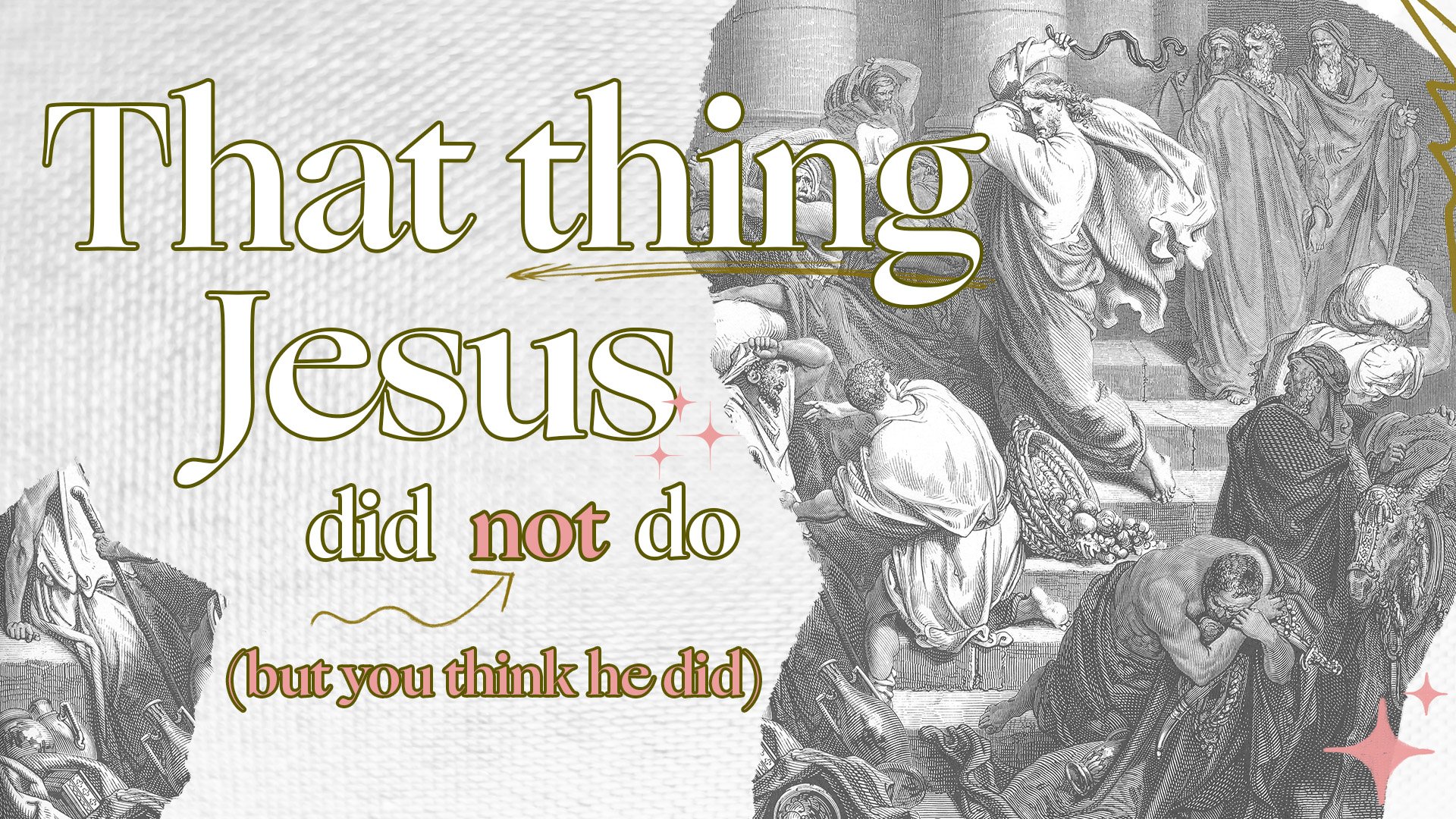
That Thing Jesus Did Not Do (But You Think He Did)
he common reaction to this scene in John is that Jesus walked up to the temple, saw the money changers and merchants handling their business, and in a moment of pure, holy rage twisted together a whip and created an Indiana Jones salvation moment, flipping tables and screaming at the Nazis. Quite the opposite of a berserked warrior hero, Jesus is about to lay down his life and take upon himself the shame of this crooked marketplace.
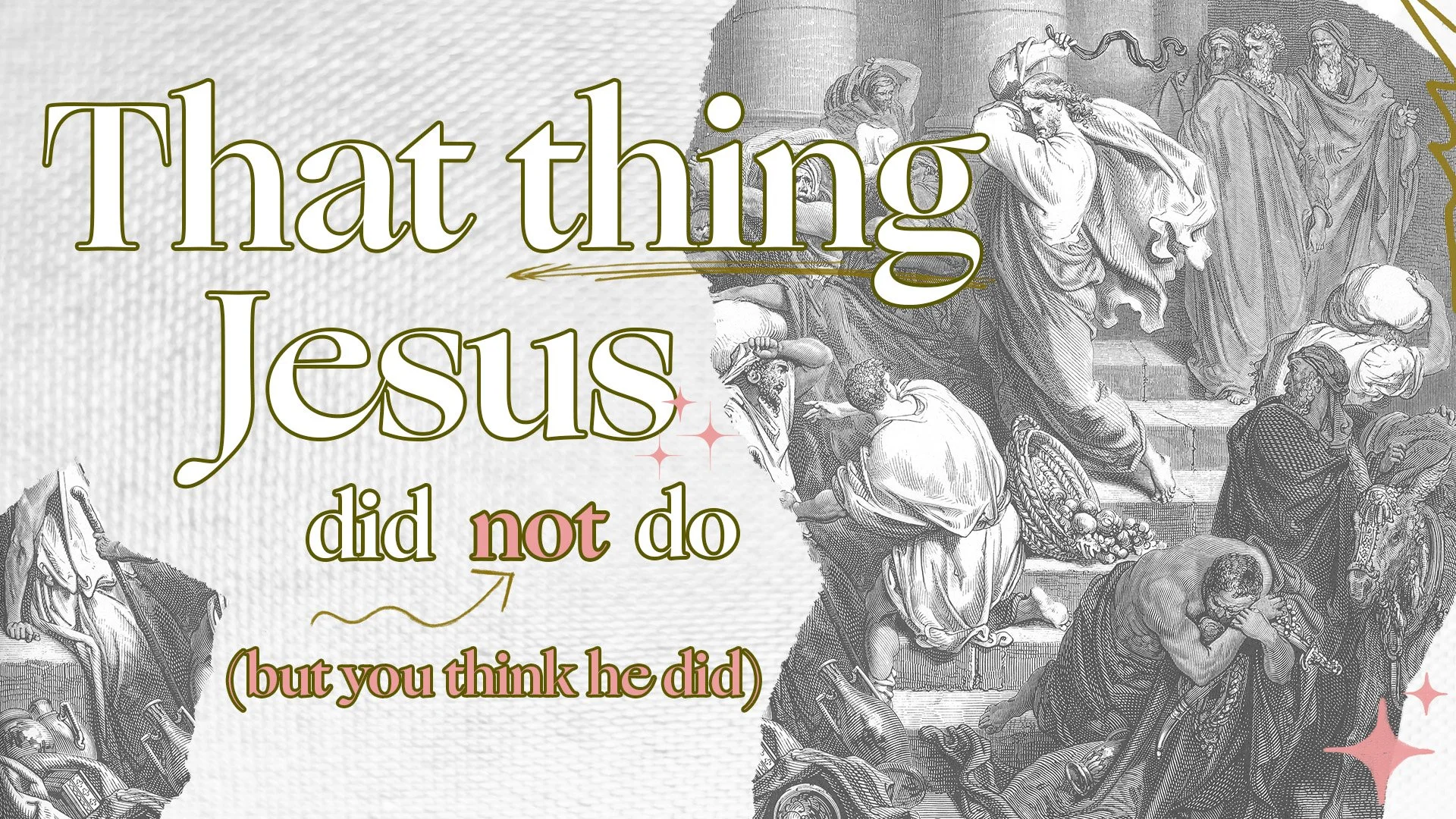
For years, memes have gone around that have some iteration of this language: “When someone says, ‘what would Jesus do,’ remember that flipping tables and chasing people with a whip is within the realm of possibilities.”
It’s funny, right?
Sure.
I understand that I am one of the most boring people on the planet. I need a better sense of humor. I’m not fun. I’ll admit that up front.
I still think this meme reveals a fatal flaw in how we see Jesus in this story. Because if we’re not careful, we’ll think that even on some funny level, this story shows Jesus being angry, forceful, and donning a sort of mid-century John Wayne grit amidst a bunch of crooked religious higher-ups and politicians.
And maybe there’s a slight twinge of truth in that last idea, but I wouldn’t even go that far.
The common reaction to this scene in John is that Jesus walked up to the temple, saw the money changers and merchants handling their business, and in a moment of pure, holy rage twisted together a whip and created an Indiana Jones salvation moment, flipping tables and screaming at the Nazis.
Let’s read it (This excerpt is from John chapter 2, though the story shows up in each gospel):
The Jewish Passover was near, and so Jesus went up to Jerusalem. In the temple he found people selling oxen, sheep, and doves, and he also found the money changers sitting there. After making a whip out of cords, he drove everyone out of the temple with their sheep and oxen. He also poured out the money changers’ coins and overturned the tables. He told those who were selling doves, “Get these things out of here! Stop turning my Father’s house into a marketplace!
There you have it. Jesus shows us righteous anger and wipes the floor of all evil; so let’s not throw out the possibility that Christians might need to brandish their whips and flip tables when something is corrupt.
With love in my heart, I would like to wholeheartedly reject that idea.
Jesus grew up within the second-temple Jewish tradition (Lk. 2:21-24; 41-47; 4:16), and visited the temple numerous times throughout his life. Flavius Josephus describes the bustling marketplace of the temple that existed in Jesus’ day, so this was not a new development that popped up during his visit in John’s gospel. Jesus saw this corruption every time he went to Jerusalem and visited the temple. The audacity of the marketplace corrupting the temple was no surprise to Jesus.
So why did he choose this visit to drive every merchant out of the temple?
If you look at this story in all four gospels, you’ll find that they all share a couple of elements of the narrative. (Only in John does he “make” a whip and pour out coins. In Luke, he doesn’t overturn any tables. In Mark, he stops people from carrying their goods into the temple. In Matthew and Mark, he overturns the seats of the dove sellers.)
But one event takes place in all four gospels: He drives out the merchants.
And he says these powerful words, “Stop turning my Father’s house into a marketplace!”
The Greek plays on the word “house.” The Greek phrase (οἶκον ἐμπορίου) often translates as “marketplace." But in English, this misses the clever wordplay. John is highlighting not the offensive activity itself, but its location. The “house” of God, the temple where His presence dwells, is meant to bring love and justice to those graced by it. The holy presence of God should fill the “house,” and Jesus (who is God himself, the true light, life, temple, bread, water, vine, land, and source) alone has all authority to correct this injustice.
The issue at play is that a place meant to act as the divine dwelling between heaven and earth, the safe and sacred living room between the God of the cosmos and his beloved creation, has become a place where those unfit to offer what God truly desires (the religious elite) have turned it into a system that elevates themselves at the expense of others. But Jesus chooses this moment to initiate his “cleansing” of God’s house because this story sets in motion a series of events that lead to his ultimate sacrifice. In the other three gospels, this narrative occurs during Jesus’ final week of ministry, before he is arrested and sentenced to death. In John, the story happens much earlier, but that’s because John is making a bigger theological claim.
Watch this.
Go back to the beginning of John chapter 2. You’ll notice that Jesus attends a wedding, where he performs a rather simple miracle, turning water into wine. This story is teeming with beautiful imagery: Jesus takes ceremonial washing jars used for ritual purification and produces the most satisfying wine the master of the banquet has ever tasted.
Imagine God the Father is the master of the banquet, and all the wine that came before this moment was not satisfying. It wasn’t perfect; it wasn’t truly what the Master considered “the best” (John 2:10). Now, imagine the wine is the blood of every sacrifice in the Old Testament system. It was never enough. It never satisfied. It always needed something more. Then Jesus shows up, and he (only he) produces the wine that finally satisfies, and the Father says, “This outtastes every offering that ever came before.”
Jesus, who was initially the guest at the wedding, became the host and satisfied perfectly every need among the people and the master of the banquet. Jesus has come to once and for all offer the greatest offering that could be offered, and he himself will become that offering, displacing all other offerings.
Now look again at Jesus as he drives the merchants from the market who dare attempt to make sacrifices available for the people, and at a profit no less. Jesus removes them, but ultimately sets in motion a series of events that will lead him to take the place of every sacrificial offering sold in that market. He doesn’t just displace them, he becomes them. John needs this narrative to take place earlier in the story to show how this action ties to Jesus’ role as both God and sacrifice, displacing and fulfilling the entire sacrificial system. Because after this moment in John’s gospel, people start to believe in Jesus, and whenever people believe in John’s gospel, Jewish elites start hunting him.
Not only is Jesus self-controlled and non-violent in this story, but he is also preparing everyone for his self-sacrificing act.
As Edward Klink puts it, “God in the person of Jesus has just entered his temple, declared it unclean, and has prepared to receive its shame himself.”
Quite the opposite of a berserked warrior hero, Jesus is about to lay down his life and take upon himself the shame of this crooked marketplace. That's why John, the author, cites Psalm 69:9: “zeal for your house will consume me.” Because the people revile God with their twisted worship, and they are about to revile Jesus as well. But Jesus willingly takes on their disdain so he can give God what everyone needs and what God truly wants: The perfect offering that will end all offerings. Jesus is intentional and calculated. Now is the time to repurpose practices in the temple courts, which Jesus says will be destroyed and rebuilt in three days.
He’s talking about himself, not the physical temple (2:19-21).
Jesus will perform the most powerful act in all of history: He will stand up to the epitome of brutal, grotesque violence in the known world, the Roman Empire, and willingly lay down his life for their sake, undoing their power and restoring the presence of God to the “house” of God.
The same God who once established these sacrificial rites is now walking among you, fulfilling this system with a more perfect one and driving out the corrupt corporate seats of power, just as He drives out the corrupt seats of power in the whole cosmos and tramples over them in victory (Col 2:15).
The same God who commanded offerings and sacrifices to facilitate his presence will become the one, perfect sacrifice, sufficient once for all, more satisfying than all sacrifices that came before.
Every animal offering is now useless; every currency and cost now worthless, and every market intermediary jobless. The “house” of God needs no such things anymore, and no one will be given the chance to exploit the system ever again, for Christ has come to fulfill it all, and in Him the presence of God will dwell fully.
That's the beauty of the temple cleansing narrative, and it’s the beauty of the dynamic, sacred actions of Jesus, who himself has the authority to drive everyone out and restore the house of God to what it was always meant to be.
The death and resurrection of Jesus will be the ultimate temple cleansing.
Peace, gentleness, and self-control will always be considered fruits of the spirit (Gal. 5:22-23), and no story of Jesus should be twisted to undermine them. We don’t have to mistake passion for emotional intensity. Jesus was passionate, but he was not out of control.
I wonder sometimes if we in the West have an obsession with emotional intensity. We like big revivals and spitting preachers. We like busyness and frenetic paces. We like loudness and forcefulness and wild abandon, and there is nothing inherently wrong with all of those things. But maybe we paint Jesus in a light that matches that intensity because we want Jesus to conform to our image rather than be conformed to his. Do we really need a loud, angsty, short-tempered, aggressive Jesus to defeat evil? Does Jesus need to be a cowboy of the wild west to be victorious? We all want to see the humanity of Jesus so we can resonate with him who understands our pain and suffering (Heb. 4:15), but how far do we take that?
These are not rhetorical questions. Can we at least stop and ponder them for a bit?
Did Jesus crash out?
I don’t think he did.

Santa: the Man, the Myth, the Legend
Every December, Saint Nicholas reappears, smiling, generous, wrapped in legend. For some parents, he’s a lie to be exposed. For others, a positive myth to be defended and celebrated. To others still, he’s the embodiment of commercialism and colonialist hedonism.
But Saint Nicholas is best approached neither with suspicion nor sentimentality. Approach him with theological curiosity.
Before Saint Nicholas became a symbol, he was a pretty awesome follower of Jesus.

Every December, Saint Nicholas reappears, smiling, generous, wrapped in legend. For some parents, he’s a lie to be exposed. For others, a positive myth to be defended and celebrated. To others still, he’s the embodiment of commercialism and colonialist hedonism.
But Saint Nicholas is best approached neither with suspicion nor sentimentality. Approach him with theological curiosity.
Before Saint Nicholas became a symbol, he was a pretty awesome follower of Jesus.
The Man Behind the Stories
Nicholas lived in the late third and early fourth centuries (270–343 C.E.), serving as bishop of Myra, a port city in what is now southern Turkey. This was not a romantic era for the church. It was marked by economic instability, persecution, and loads of theological conflict. Following Jesus publicly, primarily as a church leader, entailed significant risk.
Nicholas likely experienced imprisonment during the Diocletian persecutions (303 C.E.), when allegiance to Christ came at the cost of safety and social standing. This matters. His generosity was born from intense conviction. He lived the kind of faith that assumes Jesus really meant what he said about loving the poor, protecting the vulnerable, and storing treasure where moth and rust do not destroy.
Charity That Refused Applause
The most enduring story about Nicholas tells of a desperate father with three daughters who faced exploitation because he could not afford dowries. Under the cover of night, Nicholas secretly provided gold, enough to secure their futures without exposing their shame.
Whether the gold was dropped through a window, placed in stockings, or left quietly at the door, the heart of the story is unmistakable: this was generosity that preserved dignity. Nicholas believed in the liberation of the poor and the justice of God. He gave anonymously, aligning perfectly with Jesus’ teaching to give in secret, trusting God rather than reputation. This account is recorded in Vita Sancti Nicolai (by Michael the Archimandrite). This story endured in church history because it embodied gospel-shaped hope, regardless of its dramatic nature.
Nicholas was remembered not only for giving, but for intervening. Ancient accounts describe him advocating for wrongfully condemned prisoners, confronting corrupt officials, and standing between vulnerable people and abusive power. He was, in this sense, a shepherd who understood that pastoral care includes resistance.
The Kingdom of God, after all, is not only generous but also confrontational toward injustice, just like our boy, Saint Nick.
The Punch That Probably Didn’t Happen
One of the most famous legends surrounding Nicholas claims that he struck Arius at the Council of Nicaea over a dispute about Christ’s divinity. Most historians agree this story is almost certainly not factual. It appears centuries after the council and bears the marks of devotional exaggeration. Nicolas was alive during the council, but that’s about all we know.
And yet, the legend tells us something true.
It reflects how deeply Nicholas was committed to defending the full identity of Jesus as fully God, not a diminished version palatable to the empire. The church remembered him as someone who would not compromise Christ’s nature, even if the story amplified his zeal into violence. Legends often do this. They dramatize character in ways history cannot fully verify, but theology can still interpret.
How Legends Are Born
Saint Nicholas did not set out to become Santa Claus, of course. He did set out to follow Jesus. Over centuries, stories of his generosity spread across cultures. His feast day (Dec 6th) became associated with gift-giving, and his concern for children became a focal point of celebration. By the thirteenth century, his image had been reshaped by folklore, poetry, and commerce (not the capitalist twist you might think, though).
But the legends did not appear out of thin air. They grew where his Christ-like justice and love left a mark. Byzantine liturgical texts for Nicholas’ feast day, homilies, and hymns describing him in the East, and Jacob of Voragine’s Legenda Aurea (1260 C.E.) in the West helped solidify these stories into the legends they would later assume, and they weren’t terribly romanticized. They were actually helpful.
Legends often arise when ordinary obedience produces extraordinary fruit. They are not lies so much as testimonies enlarged by time, attempts to articulate the weight of a life that reflected the Kingdom of God so clearly it demanded retelling, spurring inspiration. I’m not saying legends should be believed wholesale, but I am saying they become legends for a reason, and Nicolas gave us some good reasons. The symbolism of gold landing in stockings, chimney entrances, and golden balls didn’t take shape until the late medieval period, to make it easier for churches to teach stories in catechisms.
Saint Nicholas reminds us that discipleship is material and costs us material things. It costs money, reputation, safety, and comfort. It happens quietly, often anonymously, and usually without applause (Americans, that one stings).
He also reminds us that truth and compassion belong together. That generosity can be strategic. Defending the vulnerable is a form of worship. And that when the church lives this way, stories will follow, some factual, some legendary, but all pointing back to a deeper reality.
Before Saint Nicholas became a myth, he was a man who trusted Jesus enough to give his life away.
And maybe, just maybe (Anthony Hopkins voice here) that is why his story refuses to disappear.
Why It’s Okay to Practice the Way
John Mark Comer’s latest work Practicing the Way is a prophetic call to the Western Protestant traditions of faith that we can no longer ignore the aching need to have an embodied faith that turns professing Christians into practicing disciples. However, many within Reformed Evangelical circles have taken issue with Comer’s book, especially concerning his language on mysticism, his emphasis on spiritual formation, and his hermeneutic on the life of Jesus. As a supporter of Comer’s work, this article is my attempt to evaluate Practicing the way against Reformed Author and Scholar Kevin DeYoung, who published a critique of the book.
This article is my response to a review Kevin DeYoung published online for John Mark Comer’s Practicing the Way, a book Comer released in January of 2024. It must be stated that I am not writing this response because I expect Kevin DeYoung to grapple with it. He is a known Reformed Scholar and established author, and I’m no one of note. He will never see this. I am addressing DeYoung’s review because numerous people have approached me in the last year with serious concerns about Comer’s book, and most of their concerns reflect a theological leaning that authors like DeYoung often influence. After speaking to so many people about my thoughts on Comer and Practicing the Way, it would be easier for me at this point to write my thoughts down and share them with anyone who has questions in this format. When people bring their concerns to me about Comer, and I ask them what sources they use to confirm their concerns, they often send me video links to fundamentalist Protestant YouTube pastors. I’m choosing to respond to DeYoung’s article instead because he is a known, credible, influential scholar, and I respect his message and ministry. I also think he articulates his concerns about Comer’s work well, and he’s gracious in his criticism. The flow of this article follows Kevin DeYoung’s critique of Comer’s work. I do not hold all the same theological views as DeYoung, nor do I identify with the Reformed tradition, so many of my critiques of DeYoung’s review will be based on these differences. One thing I truly appreciated about DeYoung’s review is that he acknowledges the faith traditions that influence Comer beyond his own. He warns his readers about these differences right away. His main aim, he claims, is to speak to people who value Reformed theology and to help them recognize the concerns he sees in the book.
My response to DeYoung’s review is extended. Yet I still did not have the space to grapple with every aspect of his concerns and challenges fully. I hope you find my assessment of his review helpful and that it explains why I continue to support Comer’s work and “practice the way.”
The Way?
DeYoung’s first two concerns are that Comer spends a significant amount of time discussing how “The Way” in the Book of Acts of the Apostles and “discipleship” refer to a spiritual and ethical method for following Jesus, thereby minimizing what reformed Protestant church traditions prioritize. DeYoung mentions specifically repentance, receiving the good news of the gospel, and the Reformed soteriological (salvation) implications of this (going to heaven and avoiding hell/God’s wrath). DeYoung believes this language will lead people to an understanding of the gospel that focuses more on how Jesus lived and less on what Jesus did to save souls from sin.
The early Christians were called followers of the Way, not first of all because they were apprentices to Jesus trying to do what he did, but because they believed Jesus was the long-awaited Christ and that in his name, and in his name alone, men might be saved.
First and foremost, I respect DeYoung’s concerns. Jesus is absolutely more than a model for human behavior. He defeated the powers of sin and darkness and overcame the greatest weapon of evil (death) with his resurrection. If Jesus were only a model, we’d all still be slaves to sin. Of course, no one who promotes the Contemplative Tradition believes Jesus was only a model.
That being said, I want to discuss what the word “saved” means. Nearly 40% of the New Testament (NT) consists of teaching principles that instructed first-century followers of Jesus on how to live. Scholars who study Greco-Roman letter structure and biblical rhetoric often divide NT writings into two main sections: Indicative (what God has done in Christ; proclamation, doctrine, theology), and Imperative (how we are called to live in response; ethics, lifestyle, exhortation)
While these categories often blend, here are some estimates: In Paul’s Letters (about 30% of the NT): Around 40–50% are exhortation/commands (Romans 12–15, Ephesians 4–6, Colossians 3–4). The rest may be considered theology, narrative, or prayer. For example, Romans 1–11 is almost entirely theology, while Romans 12–16 is almost entirely about living faithfully. In the Gospels (about 45% of the NT), Jesus’ teaching (Sermon on the Mount, parables, kingdom ethics) takes up a significant portion, perhaps 30–40% of Gospel content, which is moral/ethical instruction. The rest is a narrative about who Jesus is, what he did, and his death and resurrection. General Epistles & Revelation (about 25% of the NT): Books like James, 1 Peter, and 1 John are heavily ethical/exhortational. James is 60% about how to live. Revelation is more apocalyptic, but still calls the churches to endurance and faithfulness (25–30% exhortation). The point is that scripture gives ample attention to how Christians should live and ample instruction on how to imitate Jesus. Explicitly, John 13:13-14, Philippians 2:5-8, 1 Peter 2:21, Ephesians 5:1-2, Colossians 3:13, 1 John 2:6, and a host of others. Jesus as a model is not an antithetical theological framework to Jesus as an atonement for the penitent. DeYoung is concerned that people will find more ethical value in Jesus than soteriological. But these two concepts are not in opposition to each other. In fact, based on the entire Jewish Rabbinic tradition common to the first-century church with talmidim (disciples) and their rabbi (teacher) (Comer explains them to modern readers as “apprentices” to make the concept of discipleship more digestible to a contemporary audience), the New Testament clearly has a lot of dependence on Comer’s understanding of these instructions. Let’s look at some:
Matthew 4:19; Mark 1:17; Luke 5:27
In first-century Judaism, “follow me” was a technical phrase.
To follow a rabbi meant to: attach yourself to him, to live with and learn from him, to imitate his halakhah — his interpretation of how to live the Torah.
“Take my yoke upon you and learn from me.” A rabbi’s “yoke” meant his teaching, his way of interpreting Torah, and the lifestyle he required of disciples.
“Learn from me” (mathete ap’ emou) is literally discipleship language.
Jesus is presenting Himself as a rabbi offering His yoke, one that brings rest rather than burden.
“A disciple is not above his teacher, but everyone when fully trained will be like his teacher.”
This is pure rabbinic logic.
The goal of discipleship was not only to learn knowledge but to become the kind of person your rabbi is; to “be like” him in practice and character.
“Be imitators of me, as I am of Christ.”
Ancient disciples were expected to imitate their rabbi in speech, conduct, piety, mannerisms, priorities, and ways of interacting. Paul uses mimetic language (μιμηταί), a core feature of Greco-Roman and rabbinic education, to describe Christian formation.
“… he ought to walk in the same way in which he walked.”
This is the most explicit rabbinic-style imitation command in the NT. “Walking” (halak in Hebrew) is the root of halakhah — the rabbi’s way of life. John tells believers to follow Jesus' halakhah. That’s unmistakably rabbinic.
DeYoung does not fully articulate what repentance and salvation are in his critique, so I cannot quote him here. Still, my best brief explanation of Reformed soteriology is this: In the Reformed Protestant tradition, “salvation” means that God graciously justifies sinners by imputing Christ’s righteousness to them through faith alone, delivering them from sin’s guilt and wrath in hell, and securing their eternal reconciliation with Him. That’s what it means to be “saved.” Here’s my larger disagreement with DeYoung’s concerns in this critique, and here is my key disagreement with reformed scholarship in general: What did the gospel of Jesus Christ actually save people from? What is “the way of salvation?” If it’s the wrath of God and eternal torment in hell only, then I, along with a host of Biblical Scholars, would argue that this wasn’t good news to most of the Roman Empire at the time the Church began. It is a dualistic, platonic, and frankly, semi-Gnostic understanding of the universe to claim that God’s wrath against sin and eternal separation from God are the only things God restored through Christ’s passion and resurrection as prophesied in Isaiah 40:3. Here’s an extremely brief overview of the numerous, rich, theologically sound, and ancient understandings of what Christ accomplished in the thoughts of New Testament believers according to scripture:
1. Victory over Satan and Demonic Powers
Genesis 3:15 – The “protoevangelium”: the seed of the woman will crush the serpent’s head.
Colossians 2:13-15 – “He disarmed the rulers and authorities and put them to open shame, by triumphing over them in him.”
Hebrews 2:14–15 – Jesus shares in flesh and blood “that through death he might destroy the one who has the power of death, that is, the devil, and deliver all those who through fear of death were subject to lifelong slavery.”
1 John 3:8 – “The reason the Son of God appeared was to destroy the works of the devil.”
2. Liberation and Deliverance
Exodus Typology (Exod. 12–15) – Israel’s liberation from Egypt functions as a pattern of God defeating oppressive powers through redemption. The NT echoes this pattern in its description of Christ’s work.
Luke 4:18–19 – Jesus’ inaugural sermon: “The Spirit of the Lord is upon me… he has sent me to proclaim liberty to the captives…”
3. Triumph of Self-Giving Love
John 12:31–32 – “Now is the judgment of this world; now will the ruler of this world be cast out. And I, when I am lifted up from the earth, will draw all people to myself.”
Romans 5:18–19 – By one man’s obedience, many will be made righteous; a restorative, life-giving victory over Adam’s curse.
4. New Creation & Cosmic Renewal
Romans 8:19–21 – Creation waits with eager longing for liberation from bondage to corruption.
2 Corinthians 5:17 – “If anyone is in Christ, he is a new creation.”
Revelation 21:1–5 – New heavens and new earth, death defeated, all things made new.
These scriptures receive profound elaboration from scholars such as Greg Boyd, Joel B. Green, N.T. Wright, Michael Gorman, John Barclay, Fleming Rutledge, Gustaf Aulén, and a grand host of others who have spent their careers exploring the ramifications of Christ’s death and resurrection and the language of the early church regarding it. They uniformly agree that the good news of the gospel was actual, physical good news to a world in slavery to the empire, suffering under discrimination, and death at the hands of extreme violence. The way of life was liberated from the tyranny of both imperial and demonic institutions, so that humans could recover the vocation of worshiping God and stewarding His good creation in their daily lives.
Clearly, I believe in a salvation message that has soteriological implications beyond the Reformed emphasis (Penal Substitutionary atonement). Past this simple nuance in DeYoung’s theology and my own, however, lies my greater conern with critics of Practicing the Way: This notion that you are a wretched sinner who is only able to grow in God’s grace (if I’m even allowed to say “grow” to my Protestant friends) is an idea put forth firmly by every Southern Baptist, Methodist, Presbyterian, and all around Protestant church within the tradition. The message is that if you can embrace the reality that only God’s Spirit can awaken grace in you and reach this paramount mental ascent about God’s grace (that you better take no credit for), you’ll suddenly want to be a “better Christian.” And to all of that I say, “Yes. Amen! Only God can turn the heart. Only by His grace.”
And yet those denominations are bleeding congregants and starving for what to do after this awakened experience. The modern-day Protestant church has risked abandoning discipleship for fear of almost discussing works within the Christian life.
And when the church doesn’t disciple, someone or something else will. Phones and influencers and cultic pop-thought and politics and people with TikTok doctorates are discipling the Protestant church. The 5 Solas of the Reformation are not discipling the Protestant church. The solas are beautiful. They are a gift. They are a symphony in a world of flat noise. But they are an incomplete expression of the gospel as a whole. They are a minuet: the gospel is a symphony, and discipleship and spiritual formation make up some of the missing pieces of the music. This is why Generation Z is flocking to Comer’s work. It isn’t because they’re young and easily led astray by esotericism. That’s often the criticism of younger generations: that they’re cowards who want a watered-down gospel, so they focus on TED Talk instructions rather than hard biblical truths. But studies show young people are the opposite: They’re pursuing strict, rigid, embodied faith, tired of the free-market therapeutic deism of their parents and grandparents. The next generation wants a faith that isn’t Gnostic. They want a faith that is grounded in the physical world, embodied in authentic experiences, and recaptured as tangible hope in a broken world. That means they want discipleship and spiritual formation, not a distant promise that they skipped hell and made it to some wispy spiritual heaven someday after they’re done enduring discipleship on earth by everything that isn’t Jesus.
Lifestyle Discipleship
Continuing DeYoung’s concerns over discipleship language within scripture, he challenges Comer’s use of John 14:6 as a paradigm for following Jesus, which Comer says is “the marriage of his truth (his teaching) and his way (his lifestyle) is how to get to the with-God life he offers.”
“[Comer’s] novel interpretation fails to take into account the context of John 14, which is about believing in Jesus (14:1), and about how to go to the “place” that Jesus prepares for the disciples (14:2–4), and about how they come to know the Father (14:6), and about how they see the Father (14:9), and about how they too can go to the Father (14:12). Comer’s interpretation ignores all this and makes Jesus’s statement about his lifestyle.”
This is a typical disagreement between reformed scholars and scholars within broader traditions. The disagreement is fundamentally about what the gospel is.
The early church usually held that being “in Christ” involved both trusting him and entering into an obedient, formed way of life (baptism, prayer, repentance, virtues, the life of the community/ascetic practice). The “gospel” is not primarily a message about how individuals go to heaven, but rather the announcement that Jesus of Nazareth is Lord, the true King of the world, and that through him, God’s long-awaited kingdom has been inaugurated on earth as in heaven. Sin, death, and evil have been defeated through the cross and resurrection. Those who trust and follow Jesus become part of this renewed creation and join in God’s mission to restore the world (Isa. 42:7; Mark 1:14-15; Rom. 1:1-4; 1st Cor. 15:1-8; Phil. 2:9-11; cf. Isa. 45:23). This is not a “novel interpretation” as DeYoung calls it, but a historical approach to what it means to put your pistis (faith) in Jesus. Justin Martyr (First Apology, Dialogue with Trypho) taught that Christians are saved not by profession alone but by living according to the Logos (Christ). Irenaeus of Lyons (Against Heresies, Demonstration of the Apostolic Preaching) believed Jesus saves not only by dying but by living in perfect obedience and inviting believers into that same obedient pattern. He writes that believers must be “conformed to the image of the Son,” sharing in his obedience to the Father. Origen, Basil the Great, Clement of Alexandria, John Chrysostom, and several others believed that repentance and faith included allegiance and obedience. Those are easily synonyms for “practicing the way.”
Again, this does not mean that the gospel is only a model of obedience and lifestyle, and that is a valid point DeYoung emphasizes. Still, we certainly shouldn’t exclude those basic elements of human life and free will when we look at what the good news of salvation is. It is freedom to obey Christ and walk with Him intimately for eternity, and the powers of sin and darkness can’t stop you.
Another primary issue at play for DeYoung is Comer’s interpretation of the “Narrow Gate” in the Sermon on the Mount:
Instead of embracing the traditional understanding of Jesus’s words, Comer finds a different interpretation “more compelling,” namely that if you walk in the broad way of the majority culture, your life will fall to pieces, “never reaching your promise or potential” (27). I’d say “never reaching your promise or potential” is a pretty soft sell on the word “destruction,” especially when the context is clearly eschatological. Jesus is not simply talking about a dysfunctional life falling to pieces because of our poor choices. He is talking about “workers of lawlessness” who will be condemned by him on the day of judgment (Matt. 7:23). I don’t know what Comer believes about judgment and hell, but he often goes out of his way to explain away notions of divine wrath and punishment.
Calling the “Narrow Gate” a pathway to heaven and its opposite a path to hell is, in fact, not a traditional reading of the text. In Second Temple Judaism, “the way” (Heb. derek, Greek hodos) was standard moral/ethical language. Psalm 1 contrasts “the way of the righteous” vs. “the way of the wicked.” The entire Psalms corpus is introduced as a method of living within the covenant mercy of God by choosing to obey God’s instructions in a discipled life. The Qumran community (the Dead Sea Scrolls) used “the Way” to describe their distinct lifestyle and teachings. Second Temple rabbis contrasted the “narrow path” of wisdom vs the “broad path” of folly. Jesus is using well-known Jewish metaphorical language: choosing a teacher, a way of life, a halakhah. This background points heavily toward discipleship rather than afterlife destinations. Jesus is saying: Choose the difficult, disciplined way of life I’m teaching you, not the easy, destructive path offered by other teachers.
The Didache, one of the earliest Christian writings outside the New Testament, begins with: “There are two ways, one of life and one of death.” (Didache 1.1) This is explicitly about ethical lifestyle and discipleship, not heaven/hell. The Didache often addresses humility, generosity, forgiveness, sexual purity, and non-retaliation. The “way of life” is essentially the Sermon on the Mount lived out. The earliest Christian interpretation treats “the two ways” as a way-of-life teaching. Writers like Barnabas, Hermas, and Polycarp also use “two ways” language to describe moral formation and obedience, not afterlife judgment. Barnabas 18–20: Two ways: one of light, one of darkness.
Hermas, Mandate 6: Two ways: truth vs. evil.
Again: This is discipleship, not eternal destinies. It is somewhat liberal to solely view the gate passage in the Sermon on the Mount as eternal destinies concerning God’s forgiveness and judgment.
To be clear, I don’t think DeYoung’s position or Comer’s is opposed to the other here. Following Jesus means committing to follow him for eternity, starting now. That means spending eternity with God, restored to creation’s original design as an image bearer, which would include being with Jesus in the New Creation when God restores all things (a.k.a the gospel). To choose another rabbi (any other path than Jesus) is to walk a path that leads to destruction both immediately and for eternity, regardless of one’s view of hell (which was also very diverse before Reformation theology).
On Grace and Salvation
A significant concern for DeYoung is that Comer’s book puts worshiping Jesus “in the background” and following Jesus “in the foreground.” Yet there is an endless amount of literature highlighting the Protestant tradition that salvation is bound up in the acknowledgement that Jesus is Lord and King of the universe, and that one day every knee will bow to him. But there is so little solid, Protestant literature on how to align your life with the kingdom of God and to steward God’s good creation well, which the entire gospel seeks to restore. I wholeheartedly agree with DeYoung that the gospel can never be truly understood without the lordship, Spiritual infilling, and saving grace of Jesus in the believer's life. But Comer doesn’t seem to be trying to re-explain any of that in a book that is primarily about discipleship. I suppose he could have made the book three times as long and rehashed the entire gospel narrative (though he wouldn’t have done so from a monergistic point of view, since he isn’t Reformed). Still, then the book would have been another theology book revisiting Augustine and Pelagius. Half the readers would have put it down, and Christians would have continued to claim Jesus is lord with their mouth while being discipled by their phones and politicians in practice.
The primary concerns in this section of DeYoung’s argument stem from a significant historical moment that needs to be addressed for clarity and context. Martin Luther and what became known as the Protestant Reformation sought to answer a specific question that was plaguing Europe and harming the laity through clerical abuse in the Roman Catholic Church: How are people “in” and how are they “out?” Who gets to go to heaven and who goes to hell? Does the Church get to decide? And if so, who speaks for the Church? What is the true efficacy of indulgences? Can we truly spend money on the Pope’s program to build a cathedral and save our family from purgatory? The Reformers wanted to address this central historical question to save people from spiritual abuse, which is why almost all Reformed theology focuses on Romans and on Penal Substitutionary Atonement language when talking about God, salvation, and eternity. But if Luther had discovered the riches of Ephesians before he dove into Romans, he would have walked away with a very different approach to answering this question, and all of Western Christianity would look very different today. Ephesians is all about creation and new creation, and how God seeks to redeem it all back to his original good purpose. There’s little to no mention of people being “in” or “out,” or at what moment or by what force a person is “saved” in the New Testament at all, but that framework is actually impossible to detect in the letter to the Ephesians. As DeYoung kindly mentioned at the beginning of his critique, he is approaching this conversation from a Reformed perspective, so I don’t expect him to respond differently here. My primary concern lies in the lack of resources available to present-day Protestants regarding historic discipleship, and in how Reformation theology, apart from robust systematic dogmatics, has not addressed this issue, beyond telling Christians to pray and read their Bibles more.
Ancient or Modern?
Deyoung’s third concern is that Comer desires to position his book into the ancient practices of the early church and the desert fathers and mothers, right up through the Reformation. He says that, despite Comer’s attempts, “Comer’s project is tailored to twenty-first-century, secular-leaning sensibilities.” When discussing the Benedictine Rule, a concept Comer leans on heavily in Practicing the Way, DeYoung argues,
The problem with Comer’s historical reconstruction… is that the vibe of Comer’s rule is nothing like the vibe of Benedict’s Rule. On one level, of course, this is not a problem. Benedict doesn’t have a trademark on the word “Rule.” Comer can call his set of spiritual practices whatever he wants. But readers should not think they are adopting something ancient, when actually they are adopting something new.
DeYoung further positions Comer’s work within modernity by framing it as a self-guided practice distinct from historically strict monastic practices, rather than the rigorous and often harsh (punishment-inflicting) life of the monastery.
[Comer] stresses that the Rule is not a law. The difference: “A law is handed down from an external source, and it has very little flexibility. By contrast, a rule is self-generated from your internal desires, it has a ton of flexibility, it’s relationally based (not morally based), and it’s designed to index you toward your vision of the good life.” I applaud Comer for encouraging us to be intentional in our spiritual formation and to come up with a plan for following Jesus. But a self-generated, flexible, not morally based vision of the good life that enables us to fulfill our deepest desires is not quite what Benedict had in mind.
I will again point out that this is a wonderful concern from DeYoung. Self-help strategies are antithetical to the gospel and should be held in contempt with every gnostic and legalistic heresy Paul preached against time and time again (Gal. 1:8-9). However, two things should be considered here. First, Comer has already emphasized earlier in this particular work that grace alone saves and that the Holy Spirit guides all acts of sanctification (116). DeYoung acknowledges this in his critique. Again, the point of this book is to focus on spiritual formation, not the implications of Penal Substitutionary Atonement. I don’t believe Comer is suggesting that spiritual maturity is an inner journey in which you follow your heart and set your own standards. This is really the first time in DeYoung’s critique that he uses a straw-man argument against Comer and stretches the argument a bit. Comer’s entire framework is that the monastic tradition (of which Luther and many reformers were a part) is rooted in a rabbinic tradition, which shares soil with all of second temple Judaism and the New Testament. That tradition states that all disciples everywhere, whether pagan, Jewish, or eventually Christian, trained themselves to be disciplined in spiritual practices, and that these disciplines have been lost in the modern West. This is something Luther, Zwingli, Melanchthon, Knox, Bucer, Calvin, d’Albret, and others took for granted and rarely taught because it was already assumed in their world. In the sixteenth century, no one participated in any valuable religion or philosophy without training themselves to be dedicated to it. Comer isn’t instructing people to follow their own compass; he’s teaching many modern spiritualists something they’ve never heard before—that you actually have to do the thing you value, not just say you believe it.
Second, DeYoung’s reliance on the spiritual authority, hierarchy, and, at times, painfully strict way of life in the monastery misses a significant shift in the global West since the Enlightenment: Individual liberty and the inalienable self-worth of all mankind have completely reappropriated how spiritual practices are applied to people today. Of course, ancient churches and monasteries were strict, authoritative, and disciplinary: The entire underpinnings of the ancient world operated in rigid, systematic hierarchies. But if a spiritual family forced rules and inflicted discipline on a congregant member today, we wouldn’t call that a church; we would call it a cult. Every single person in the Western Hemisphere now operates their life of faith through their own lens of belief and personal dedication. That isn’t the same as self-revelation or being one’s own lord and savior. That is simply an acknowledgement that we live in the twenty-first century. The Reformed Church today creates wonderful catechisms and resources for families precisely for this reason: they want to guide and encourage Christians to practice their faith in a way that they themselves must structure and commit their family to, without fear of disciplinary action. To use this sort of comparison between Comer’s approach and the Benedictine Rule seems obtuse to me, and I think DeYoung should clarify this concern further.
The Centrality of Scripture
Lastly, DeYoung brings up what I would argue is the best concern in his pushback on Comer’s work. He states that Comer's “approach to spiritual formation undermines the uniqueness of God’s word by making Scripture just one of many pathways to God.”Citing Comer’s work, DeYoung explains,
Comer argues that anything can be offered to God as a channel of grace. Think about that. Does God really minister his grace through everything? Comer gives several examples: walking your dog, taking a spin class, visiting an elderly neighbor, driving in the slow lane, reading philosophy, writing a proof for physics. He says, “you can offer any of these activities to God in hope that he will fill those spaces with his transforming presence.” But these experiences—no matter how enjoyable or beneficial—are not means of grace in themselves.
I’m glad DeYoung brought this point up. Comer would have been wise to preface his hermeneutic when using terms saturated with soteriological implications, such as “grace.” He could have spent only half a page elaborating ever so briefly on the abundant semantic meanings of charis (grace) depending on its context. DeYoung is aware of these semantics, and though he doesn’t elaborate on the point further, he undoubtedly knows that Comer does not believe any of the acts described above are forms of grace that carry an unmerited saving component. For anyone reading this who may not be aware of what I am talking about, I will give the briefest explanation, one that certainly can’t do this topic justice. Still, I will hopefully explain something scholars often discuss: what charis (grace) is and how the term operates in relationships in the New Testament.
Charis in Paul carries multiple meanings, and “unmerited favor” is only one dimension, not the word’s definition. In the Greco-Roman world, charis meant “gift,” “favor,” or “generosity,” often given in exchange for worth and with the expectation of reciprocity. Paul reshapes this concept by highlighting its incongruity—God gives to the unworthy (Rom. 5:6–8; Eph 2:1–9)—but he also uses charis for divine empowerment (1 Cor. 15:10), apostolic calling (Gal. 1:15), ministry gifts (Rom. 12:6), gratitude (1 Cor. 1:4), and the overall economy of God’s kindness (Titus 2:11). Paul perfects certain aspects of grace (priority, incongruity, efficacy) without making “unmerited favor” the definition. Thus, charis is richer and more varied than the narrow sense often assumed. In the ancient Mediterranean gift economy, a charis (gift) was usually given within a relationship of reciprocity, took the recipient's worth into account, and was expected to be met with gratitude (“gift and gratitude”). Within this framework, grace and gifts (both charis) are good things created by God, placed within the believer to be used (operated out of) for God’s glory as the believer dwells with God in His presence. This is precisely how Comer uses the term. There is no efficacy for salvation by means of grace in this conversation at all. Salvation may be by grace alone, but grace does not belong to salvation alone.
Another sticking point for DeYoung is how Comer utilizes the concept of “abiding” in Jesus in the gospel of John,
Comer teaches that the way to be with Jesus is to abide in Jesus. He notes that “abide” translates the Greek word meno, which is used ten times in John 15. According to Comer, when Jesus says “abide in me,” he is saying, “Make your home in my presence by the Spirit, and never leave” (37). Being an apprentice of Jesus is about letting your body become God’s home. Jesus calls this abiding (39).
In response, DeYoung takes an entirely different exegetical approach than Comer,
But that’s not what Jesus means by abiding in him. In John 15:7, Jesus uses two concepts interchangeably: abiding in him and his words abiding in us. Jesus is with us when his word is with us, and we are in him when his words are in us. There is an intimate connection between the person of the Word of God and the words of God in speech and in Scripture. The eternal Logos is the mediating agent in creation, in redemption, and in revelation, whether by means of the word spoken (and later written down) or by means of the Word made flesh.
I appreciate this concern greatly. Scripture is the most wonderfully preserved and beautifully disclosed summation of God’s faithful proclamation to be the Creator and Sustainer of all things; things that He Himself will redeem and renew at the consummation of His kingdom in the New Creation at the end of the Age. DeYoung follows in the footsteps of the Reformed tradition by defending the sacred authority of scripture, and he rightly contends that Comer makes little to no mention of this in his work. While I see no problem with Comer’s exegesis, it would again have been wise for Comer to include some sense of his hermeneutic when using such popular scriptures in a manner many protestants have never seen before.
Where I disagree with DeYoung is his proposal that the Logos (λόγος), as the written word, is the key to abiding in Jesus. This is a common issue I hold in general within Western Christianity. Scripture is beautiful, and it is the highest authority in the life of the believer, but it is not Jesus. It speaks of Jesus, reveals Jesus, and upholds the perfect revelation of the Godhead until the inauguration of God’s kingdom. But in the gospel of John, Jesus replaces via fulfillment the temple (2:19-21), Passover (1:29, 19:36, 6:1-50), Tabernacles (7:37-39, 8:12), Hanukkah (10:22-30), the purity system (2:1-11, 13:8-10), the traditions of the patriarchs (4:12-14), Moses and the Torah (1:14-18, 5:39-47, 6:32-35) and the holy land of Israel (1:51, 4:20-24, 15:1-8; cf Is. 5). You could argue that by fulfilling the Torah, we abide with Jesus within scripture, but that’s a very reductionist approach to the theological perogative of John’s gospel. It misses Comer’s point entirely anyway: The goal of being immersed in scripture is to be with Jesus. The goal of everything within the salvation arc of scripture and history is to be with Jesus. David did this, as did Moses, the disciples, and the Apostle Paul. While I believe that scripture is entirely God’s word and that it carries God’s authority, I tread more carefully than DeYoung in assuming that scripture itself is a 1:1 form of the Logos John describes in his gospel. DeYoung does not outright say this, but he implies that Comer is not saying it, and fits the absence of such an approach into his critique of Comer.
Conclusion
DeYoung's critique of John Mark Comer’s Practicing the Way raises legitimate concerns from a Reformed perspective, particularly regarding the primacy of soteriology, the authority of Scripture, and traditional interpretations of salvation and judgment. Yet, when viewed through the lens of first-century Judaism, Greco-Roman letter structure, and the broader early church tradition, Comer’s emphasis on discipleship, imitation of Christ, and spiritual formation is neither novel nor contrary to the gospel. Instead, it reflects an integrated understanding of salvation as both gift and lived reality, where grace initiates and sustains life in Christ, and obedience, imitation, and spiritual practices shape believers into the image of the Son. By situating his work within historical practices, rabbinic pedagogy, and contemporary cultural realities, Comer addresses a persistent gap in modern Protestant discipleship: the cultivation of embodied, practical faith that engages both the mind and the life of the believer. Ultimately, the tension between Reformed soteriological precision and Comer’s holistic formation approach illuminates a broader question for the church today: how to faithfully convey the fullness of the gospel as both good news of redemption and a transformative way of life in the world.

Civil Discourse and Being Intellectually Honest
All of this is eroding civil discourse. When the opposing side is seen not as a rival but as an enemy, dialogue disappears. Instead of listening, we caricature. Instead of seeking compromise, we vilify. Social media only magnifies the problem, groupthink spreads unchecked, exaggerations take root, and mutual distrust hardens. And to top it all off, less and less face-to-face interaction removes us from how our brains attune to each other and process our differences and opposing viewpoints.

Social Media is a dark, grotesque cesspool where the worst of society curdles.
I’ll bet you think so too, regardless of your religion, political affiliation, race, gender, or social background. Charlie Kirk didn’t need to die for you to come to that conclusion.
What makes it so bad, though? Why is it that the average person, talking to someone face-to-face, seems willing to discuss most topics civilly, yet when their faces slide behind their profile, the boiled slop comes out?
I don’t have a degree in political science, so I’m not going to pretend I have expertise in this arena. But since I can remember as a child, I’ve heard people claim that Americans pride themselves on the admonition of civil discourse. At the same time, I can’t remember a moment in my life where I felt this was truly my lived experience. When it came to politics, discourse was rarely civil. Rarely.
These days, I hear so many influential political and spiritual leaders say, “If your boss/leader/pastor doesn’t respond to (X) the way I’m telling you to respond, you need to abandon that person and come over here.”
That is quite the opposite of civil discourse.
Civil discourse is the idea that we can disagree, debate, and vote differently while still respecting one another, knowing that echo chambers create blind spots. But now it’s not just that people hold different political views; it’s that they increasingly despise those who don’t share their views.
Researchers call this affective polarization, a term that describes the growing emotional hostility between members of opposing political parties. Unlike ideological polarization, which is about differences in policy, affective polarization is about animosity toward people themselves. It’s less “I disagree with your idea” and more “I don’t like you because of your ideas.”
This shift has serious consequences, and research on the subject is highlighting major issues: when we indulge in disparagement, exaggerations, and groupthink rhetoric (especially on platforms like social media), we’re pouring fuel on a fire that’s already threatening the fabric of how America functions.
How did America get to this point anyway? Pretty much since the rise of critical theory (among many other approaches to criticism), partisanship has become a social identity. I’m not blaming everything on the rise of Critical Theory in academia, but there’s an obvious shift in the 60s onward for us. Political affiliation in America now carries the weight of belonging, much like religion or ethnicity. When your political side becomes your tribe, it creates a sharp line between us and them. Once drawn, those lines are hard to erase. So, regardless of where it started, it’s here and alive on its own.
Also, we’re witnessing a period of ideological sorting. The claim is that Democrats have become more consistently liberal; Republicans more consistently conservative (at least in each other’s eyes), and every idea in between is being dumped between these two fat categories. At the same time, cultural, racial, and geographic identities have also clustered around party lines. The result is a widening canyon of difference; less overlap, less nuance, more certainty that “they” are not like “us.”
Then there is media and elite behavior, which have amplified the divide. Politicians, pundits, and commentators increasingly speak in combative terms, framing every issue as a partisan battle that “threatens our democracy” (I’ve heard that line ad nauseam every election year). Social media rewards the outrage, ensuring that the loudest and most divisive voices rise to the top of our feeds. What we consume daily isn’t measured debate; it’s highlights of hostility.
The consequences of affective polarization are sobering.
It’s changing how we relate to one another. Fewer people are willing to marry, befriend, or even interact socially with someone from “the other party,” and again, this goes beyond just politics now. It’s no longer unusual to hear people dismiss entire groups of fellow citizens as immoral, stupid, or dangerous.
All of this is eroding civil discourse. When the opposing side is seen not as a rival but as an enemy, dialogue disappears. Instead of listening, we caricature. Instead of seeking compromise, we vilify. Social media only magnifies the problem, groupthink spreads unchecked, exaggerations take root, and mutual distrust hardens. And to top it all off, less and less face-to-face interaction removes us from how our brains attune to each other and process our differences and opposing viewpoints.
The only healthy way humans are designed to process difference is through in-person discourse. Remove that and give everybody a bunch of angry videos with flat ideology, and you’ve created a Molotov cocktail of polarization, slowly catching the country on fire.
A healthy democracy requires trust; not just in institutions, but in one another. When we stop seeing our neighbors as fellow citizens and start viewing them as threats, we open the door to anti-democratic impulses. If “they” are dangerous, then maybe bending the rules to defeat them feels justified. That logic, repeated often enough, erodes the very foundation of fair and peaceful governance.
The danger won’t stop at politics. Affective polarization seeps into everyday life, straining friendships, families, workplaces, and neighborhoods. Distrust becomes a default setting. The more we caricature and disparage, the harder it becomes to cooperate on anything, whether it’s a community project, a business endeavor, or even something as ordinary as getting along with our neighbors.
The research is unsettling, but it’s also clarifying. If the problem is fueled by rhetoric, stereotypes, and tribal thinking, then part of the solution must be found in how we speak, how we relate, and how we choose to engage.
That means resisting the easy pull of groupthink and caricatures. It means remembering that our neighbors are more than their vote, and that identity is never as simple as a red or blue label. It means calling for leaders and being the kind of citizens who refuse to demonize.
Above all, it means reclaiming the lost art of civil discourse. Not a weak, watered-down civility that avoids disagreement, but a strong, principled civility that holds firm convictions while still honoring the humanity of others.
Because if affective polarization teaches us anything, it’s this: the health of our democracy depends not just on the laws we pass or the votes we cast, but on how we choose to see, and speak about, each other in the process.
Put your phone down.
Find someone.
Process your differences.
Face to face.
And watch how things change for the better.

God and Delayed Justice: John 11
John’s gospel is actually riddled strategically with a message of hope when it feels like God is ironically acting against your best interests.
Jesus begins in the narrative by purposefully being absent where he is needed (11:6-7). As the narrative continues, his involvement deepens, his responses become more personal and hopeful (23-36), and a once seemingly distant God now takes on the suffering of the people (38-44).
We’ve all asked the same question that the Jewish community was asking? “Couldn’t he who opened the blind man’s eyes also have kept this man from dying?” (11:37).
God, you’ve done harder things. Couldn’t you have fixed this?
The Lazarus miracle emphasizes that God’s purposes are not hindered by either Jesus’ delay or the reality of Lazarus’s decay; rather, these very elements are integral to the outworking of God’s sovereign will. John presents Jesus’ delay not as negligence, but as a profound expression of divine love for Lazarus and his family, and a day is coming when He will make all of it right again

More than any other New Testament story, I believe the Lazarus narrative in John 11 comforts those who feel that their suffering is not an immediate need to God. It is the longest miracle narrative in the gospel, giving incredible detail to feelings of pain and loss, and the story’s irony is completely intentional on the author’s part.
Jesus does not go where Martha and Mary ask him to, he does go where the disciples tell him not to. He interchanges “sleep” with “death” and confuses the disciples multiple times with his word Ju Jitsu. It’s almost as if every need brought to Jesus, he ignores or denies.
If you read the bible ungraciously (meaning you don’t make excuses for it or try to explain away things that seem confusing and contradictory) you’ll notice God often appears to act as though time does not matter. It’s as if we’re supposed to live in the present some reality that does, in fact, not yet exist. Take the future and hold onto it right here and now, in this space and time.
That’s exactly how God seems to frame almost everything in everyone’s story from Abraham to John of Patmos.
If we’re honest, it's frustrating, because we do live in time. We wait.
A lot.
We don’t see what God is talking about. We don’t have what God promises in our hands yet.
God promises justice, but millions of innocents die at the hands of evil throughout generations. The poor are extorted by the rich. The deceiver rides off into the sunset. The adulterer moves on and starts a new life. Children die so factories can make money. Disease was introduced to the community because some gold-hunters’ quest had devastated the locals and plagued the villages.
The mean boss keeps his fat salary, and the mom who supports 3 kids is out with nothing. Theodor Herzl is still remembered as a hero rather than a tyrant. No one was held accountable for the water in Flint, Michigan. The Darfur region in Sudan is still dealing with ongoing genocide. Children are deliberately starved in Gaza. Whatever happened to Kevin Spacey’s misconduct charges?
No matter how you try to explain it away, justice just feels… delayed.
That’s the way the Johannine community felt when the author of John’s gospel was writing for them. They likely lived between 90-110 C.E. when persecution and social prejudice was becoming more intense, especially in Palestine. Life was getting harder, and nothing was getting better.
They knew how it felt to be told, “Hope is coming!” when suffering seems to be the only thing in front of you.
“Lord, if you had just been here…” (John 11:21) Those are Martha’s words to Jesus when he finally shows up, four days too late.
God’s timing feels off. Crooked. Just wrong enough to be wrong.
But Jesus didn’t miss the miracle. He just had a better one in mind.
John 11 is the author’s attempt to keep hope alive in a community experiencing long suffering and hardship. The pain of loss is real. The darkness from deferred hope is sickening.
It even made Jesus weep (11:35).
But resurrection is a promise. You don’t get to pick the timing, but you get to keep the promise, no matter what.
John’s gospel is riddled strategically with a message of hope when it feels like God is ironically acting against your best interests.
Jesus begins by purposefully being absent where he is needed (11:6-7). But as the narrative continues, his involvement deepens, his responses become more personal and hopeful (23-36), and a once seemingly distant God now takes on the suffering of the people (38-44). Jesus is coming. That’s a promise.
We’ve all asked the same question that the Jewish community was asking, “Couldn’t he who opened the blind man’s eyes also have kept this man from dying?” (11:37).
God, you’ve done harder things. Couldn’t you have fixed this?
The Lazarus miracle emphasizes that God’s purposes are not hindered by either Jesus’ delay or Lazarus’ decay; rather, these very elements are integral to the outworking of God’s sovereign will. Jesus’ delay is not negligence. It’s a profound expression of divine love for Lazarus and his family, even if they can’t see it yet. And a day is coming when God will make all of it right again. Lazarus’ resurrection is just a taste. God does not merely accompany His children in the face of evil, but actively employs that very evil to accomplish His good purposes.

Is Easter a pagan sex celebration that was stolen by Christians?
The fact is, there is no evidence/documentation that Ishtar has anything to do with Easter whatsoever. The idea is completely made up. For one thing, Ishtar is not pronounced “East-er,” it is pronounced “Ish-taa.” It appears as (𒀭ᱥ̌ َتََر) in Akkadian, which was an adaptation of “Inanna” (𒀭宁) in Sumerian. We get “Ishtar” from the sounds these symbols represented in the ANE. And speaking of symbols, Ishtar was associated with storms and clouds (kind of like Baal in the Phoenician world), and her sacred symbol was a lion, which signified the roar of thunder in a storm. Bunnies and eggs were never involved, though bunnies and eggs certainly have been symbols of fertility in the past.

Before I say anything here, let me first make it clear that I have people in my life who are sensitive to the cultural customs of other ancient faiths. I have no intention of insulting anyone here, and the title of this blog might lead social media warriors to feel attacked and angry with me. I’d also like to point out that many tragic things took place over centuries during the colonial era, and various forms of Christianity have been tied to violent colonization. These events make the people of today sensitive to the idea that ancient cultural practices were appropriated by Western nations. I respect the heart behind this. Disentangling the etymology of Easter does not excuse the violence of colonialism.
The only reason I’m writing this is because I get asked every year (every. single. year.) if Christians should celebrate Easter when it has been appropriated by an old pagan tradition attached to a goddess named Ishtar.
My Short answer.
Yes. It’s Okay.
If you care why, keep reading.
Here’s the claim that has made the rounds on social media:
“Ishtar (pronounced ‘Easter’) was originally a celebration of Ishtar, the Assyrian and Babylonian goddess of fertility and sex. Her symbols (like the egg and the bunny) were and still are fertility and sex symbols (or did you actually think eggs and bunnies had anything to do with resurrection?). After Constantine decided to Christianize the Empire, Easter was changed to represent Jesus. But at its roots, Easter (which is how you pronounce Ishtar) is all about celebrating fertility and sex.”
People love to blame stuff on Constantine. I’ve heard a dozen made-up theories (the bible was changed under Constantine, the identity of Jesus was distorted under Constantine, the pagan festivals were replaced under Constantine, etc.), and they all have zero evidence, but sound legitimate because they brought up Constantine.
That’s a word for another day.
Back to Easter.
Ishtar is a goddess in the Ancient Near East (ANE) featured in The Epic of Gilgamesh. She was typically associated with war, fertility, and sex (many ancient god-figures were). She existed in the Sumerian pantheon and was featured in Mesopotamian civilization in various ways. The most well-known feature (outside of Gilgamesh) was Nebuchadnezzar II’s gate, built in Babylon in 569 B.C. in Ishtar’s honor.
The fact is, there is no evidence/documentation that Ishtar has anything to do with Easter whatsoever. The idea is completely made up. For one thing, Ishtar is not pronounced “East-er,” it is pronounced “Ish-taa.” It appears as (𒀭´kتََر) in Akkadian, which was an adaptation of “Inanna” (𒀭宁) in Sumerian. We get “Ishtar” from the sounds these symbols represented in the ANE. And speaking of symbols, Ishtar was associated with storms and clouds (kind of like Baal in the Phoenician world), and her sacred symbol was a lion, which signified the roar of thunder in a storm. Bunnies and eggs were never involved, though bunnies and eggs certainly have been symbols of fertility in the past.
The word Easter, according to almost every credible source, originates from the Latin phrase Dominica in albis depositis (Sunday of putting away the whites) in the second century. Newly baptized followers of The Way would wear white garments during the Easter Octave (8 days following Easter), and the term “in albis” (“daybreak,” or “break of day” in Spanish) was translated “eostarum” in Old High German. This became “ostern” (Oh-starn) in German, which turned into “Ēastrun” in Old English. You can see how we get to “Easter” from there.
Now, it is true that there is some conclusive evidence that pagan Anglo-Saxons believed in a goddess typically referred to as Ôstara. The etymology behind this is that the proper name of the deity is how the word “dawn” or “daybreak” came to be in the Anglo-Saxon languages. This does not mean that Easter itself is rooted in paganism, though. There simply wasn’t any other word that meant “daybreak” in Germanic languages. Many languages developed words around pagan deities. Think about “Saturday” (Sætern(es)dæg in Old English, which comes from Saturn, the ancient Roman god of agriculture), and how that word has no other origin outside of its pagan roots. That doesn’t mean that if I refer to “going to the park on Saturday,” I must be involved in some pagan worship of the god Saturn. That’s not how language works. Words are developed by societies and cultures based on their local beliefs and customs, even though those words can mean various other things over time. Michael Jordan is “the GOAT,” and he always will be, but the origin of what an actual goat is has nothing to do with him being the greatest of all time.
So, whether or not you want to celebrate with eggs and bunnies is up to you, but if you’re worried that people call it “Easter” instead of “Resurrection Sunday” (Sunday comes from the sun god “Solis,” btw), I’d like to ease your mind.
Don’t look for a pagan festival god behind every rock.

Sabbath: The Sacred Rebellion
It feels counterintuitive, but resting actually makes us more productive anyway. More hours don’t necessarily lead to better results. Studies back this up—overworking leads to burnout, not brilliance. Jesus Himself modeled this rhythm. He often withdrew to quiet places, choosing rest over relentless work. Sabbath restores creativity, energy, and clarity, ultimately making us more effective in the six days we do work.

Our world glorifies hustle. In light of this, have you ever thought about Sabbath rest as an act of quiet rebellion?
Think about it.
It is a declaration that we are not slaves to productivity, nor are we the center of the universe. Sabbath becomes a countercultural practice that pushes back against an abusive, work-obsessed culture.
From the beginning, God designed Sabbath as a gift. Juxtapose that with Israel’s life in Egypt, where time equals more burdens and more labor. In Exodus, God commands Israel to rest—not just as a religious practice, but as a rejection of Egypt’s slave-driven economy. The Israelites had been conditioned to believe their purpose and provision were tied to how many bricks they could make. Sound familiar? Today, we live under a different kind of Pharaoh: endless notifications, mounting deadlines, and the nagging pressure to do more, be more, and produce more. Sabbath interrupts this cycle. It reminds us that we are humans, not factories.
One of the most culturally rebellious truths about Sabbath is also one of the most freeing: the world keeps spinning even when we stop. Sabbath is an invitation to step back and acknowledge that we are not the Creator, we are creatures. We rest, not because everything is done, but because we trust that God is at work even when we are not. Embracing Sabbath is an act of humility—it teaches us to let go, to surrender control, and to live with open hands.
It’s counterintuitive, but resting actually makes us more productive anyway. More hours don’t necessarily lead to better results. Studies back this up—overworking leads to burnout, not brilliance. Jesus Himself modeled this rhythm. He often withdrew to quiet places, choosing rest over relentless work. Sabbath restores creativity, energy, and clarity, ultimately making us more effective in the six days we do work.
Practicing Sabbath isn’t easy. It requires discipline to set aside time, to say no to distractions, to trust that rest is not wasted time but worshipful time. But in doing so, we participate in something ancient, something sacred. We reject the culture of endless striving and instead step into God’s unforced rhythms of grace.
Maybe it’s time to reconsider the way we approach work and rest. What would it look like for you to embrace Sabbath as an act of resistance, humility, and restoration?

Reading Paul: The New Perspective and why it matters.
For centuries (pretty much since the Protestant Reformation), ancient Judaism was viewed as a “works-based religious system.” This means that if faithful Jews followed/obeyed God’s law (given to the Jewish people at Mount Sinai), they essentially “earned” God’s promises of provision, favor, and rescue in times of need. In other words, if we follow all the rules, we legally earn our right to freedom and blessing. Scholars also looked at Romans 7:7-25 and believed Paul was saying, “No one can actually follow the Law perfectly; it’s too challenging. If obeying the law is how we all get to receive God’s goodness, we’re all doomed because we just can’t.” Paul’s letter to the Romans seems to provide the antidote to this problem by contrasting “good works” that merited God’s favor with grace through Jesus Christ, a greater avenue for God’s favor.

Some topics in biblical scholarship rarely, if ever, make their way outside of academic circles into the lives of everyday followers of Jesus. This breaks my heart.
I get it, I do.
But sometimes, these topics quite literally revolutionize the way the present-day church reads the bible, which will, in turn, transform Christian communities, worship services, prayer verbiage, outreach, and numerous other life elements for the people of God.
The New Perspective on Paul is one of those beautiful discoveries that rarely leaves academic circles but sheds light on some common misunderstandings about God’s mercy and the purpose of the Old Covenant (specifically, the law).
This is my attempt to share some of the deeply valuable truths that came out of the New Perspective on Paul conversations over several decades and why this understanding can enrich your depth of love for God and scripture.
**Disclaimer** Many will take issue with my attempt to reduce this topic to such a narrow scope and explain it so minimally; however, I believe that in this brief overview, I have maintained the integrity of the arguments and have not misrepresented perspectives on Paul in my attempts to simplify and sum up the discussion.
“The Problem of the Law” in Paul.
For centuries (pretty much since the Protestant Reformation), ancient Judaism was viewed as a “works-based religious system.” This means that if faithful Jews followed/obeyed God’s law (given to the Jewish people at Mount Sinai), they essentially “earned” God’s promises of provision, favor, and rescue in times of need. In other words, if we follow all the rules, we legally earn our right to freedom and blessing. Scholars also looked at Romans 7:7-25 and believed Paul was saying, “No one can actually follow the Law perfectly; it’s too challenging. If obeying the law is how we all get to receive God’s goodness, we’re all doomed because we just can’t.” Paul’s letter to the Romans seems to provide the antidote to this problem by contrasting “good works” that merited God’s favor with grace through Jesus Christ, a greater avenue for God’s favor.
In 1977, a scholar named E. P. Sanders challenged this understanding. In his famous work Paul and Palestinian Judaism, Sanders argued that ancient Jewish law functioned within a covenant framework where God is gracious and merciful, providing rescue through repentance and sacrifice. Sanders pointed out (correctly, by the way) that ancient Jews never believed the law could exist apart from God’s grace and mercy, and thus Jews never believed that people could be “saved” (or protected and blessed by God) simply by obeying the law. Sounds good, right? We focus so much on how the law falls short of what we need that we forget the Bible is riddled with promises in the Old Testament where God always made it clear; His grace and mercy make up for where we fail the Law. So Sanders gives us a “new perspective” from which we view God’s Law and covenant that recovers things lost over time.
Here’s the rub though.
Paul seems to contrast the Law of Moses with the grace of Jesus Christ (Rom. 9:30-10:13). Paul makes it sound as though Jewish Christians are seeking their own righteousness through the Law, but not through grace and mercy. How is this possible if the Law includes God’s grace and mercy? There’s a contradiction here. Paul even says, “No one will be justified in his sight by the works of the law” (Romans 3:20a; see also Galatians 2:16, 3:10). Paul makes it sound as though God’s law requires perfect obedience for it to work. And since no one can perfectly obey, it doesn’t work.
Hang on. Keep reading.
Sanders decides in his book that because ancient Jews did not believe the promises of God were earned by good works, apart from His grace, then Paul’s theology is self-contradictory, heavily un-Jewish, and in conflict with the Old Testament.
You’re thinking, “So this guy decided that Paul, the author of most of the New Testament, has bad theology‽”
Yeah… Hence the phrase “The problem of the Law in Paul,” which showed up in academic circles.
Okay. So what are the solutions to this problem in the New Perspective?
Real quick, and stay with me here.
There were a few solutions presented over the last few decades that scholars offered to this supposed problem with Paul’s theology.
A renowned scholar, James Dunn, is actually the guy who coined the term “The New Perspective.” He argued that Paul’s “works of the law” do not mean moral commands of the Torah (first five books of the Old Testament) but only Jewish ceremonial markers, specifically circumcision, food laws, and sabbath keeping. Said differently, the things that made a person Jewish in a pagan world are the things that make a person right with God, according to Jewish opponents of Paul, and therefore, gentile Christians (and everyone else) cannot be included in God’s covenant. According to Dunn, Paul was just pushing back against this specific teaching but was not rejecting God’s Old Covenant entirely.
This perspective has been somewhat debunked over time. The biggest reason why? Paul is definitely talking about both Jews and Gentiles (Rom. 1:18-3:20) and specifically refers to moral works of the Law as well (Rom. 4:1-8). Paul cannot be referring only to pious Jews when all mankind is referred to as being “under sin” (3:9-20).
Other solutions were offered, and they created new problems instead of solving old ones.
So what is the answer?
Ready?
Psalm 143.
Read it.
Paul is actually quoting from Psalm 143:2 in Romans, “No one alive is righteous in your sight” (CSB).
The psalmist believes it is impossible to be righteous before God apart from God’s covenant promise of mercy. The source of God’s mercy is not the Law or the sacrifices offered; it is God’s “covenant love and truth” (Exod. 34:6-7; Ps. 25:10, 40:11), and when the psalmist responds to God’s heartfelt love and mercy, he chooses to obey God. This means that in ancient Jewish thought, God always planned on human beings not measuring up, having them approach him with repentance, and forgiving them because He is merciful, something He promised to be within His intimate covenant relationship (Psalm 143:1, 6, 8, 9). In this view, God’s mercy is not a response to sacrifices and rituals. Instead, sacrifices and rituals are a response to God’s mercy.
To recap: Where Sanders was correct -
Israelites never believed they could be saved by works alone. They always believed in God’s mercy to save them. Christians misrepresented Judaism for centuries by assuming otherwise.
Where Sanders missed the mark -
Paul was not being incoherent or contradictory and was not misrepresenting ancient Jewish theology.
Paul was pointing out to all human beings that God’s grace and mercy are not a response to good works. Instead, God’s grace and mercy draw human beings into obedience and deeper love, and there is no obedience and good works outside of covenant love with God (See also Psalm 130:3-4; Isaiah 59:1-15; Daniel 9:4-19).
It is impossible to “observe the law” outside of the gracious framework of God’s covenant promises.
Okay, Joey, why does any of this matter? This sounds like it could have stayed in academic circles.
Here’s why it matters.
Many Christians misunderstand the Bible and think it teaches that God used to force people to try to obey laws they could never obey, just so he could guide them into wanting to accept grace through Jesus. In actuality, people in ancient cultures would have become very good at following laws like this. We blow out of proportion the difficulty of following the Mosaic Law. Paul himself points out how successful he was at being a law-following Pharisee (Philippians 3:4-6). Obeying the law is not Paul’s issue, and we are grateful to Sanders for pointing this out to us. Israel always believed that God’s promises needed His mercy for when the people veered into idolatry and made mistakes.
Now we know that the issue Paul was addressing is that many people believed they could obey the law of Moses apart from being in a loving, committed relationship with God Himself. Paul states that this simply isn’t possible because it is God’s loving grace that makes God’s Law profitable in the first place (Rom. 3:21-23), and that grace has now been perfectly revealed in Jesus Christ (Rom. 6:23).
In the end, ancient Jews did not believe good works could save them without God being merciful. They did, however, believe God’s mercy was a failsafe for sin, and Paul set the record straight: All those who confess Jesus is lord are, in fact, saved by God’s law, because God’s law always depended on Him being merciful first, and sought our obedience second (Rom. 10:9-10).
By the way, biblical scholars Frank Thielman, Andrew Das, Jean Noel Aletti, and N. T. Wright are to thank for these beautiful solutions to “the problem of the law in Paul” proposed by E.P. Sanders.
Okay, that was longer than I wanted it to be. But now you can appreciate what the apostle Paul did for us in the New Testament, and hopefully, you have a more robust understanding of God’s beautiful grace, the Law of Moses, and how Christ perfectly fulfilled it all.

The Bible and Culture
The bible is a collection of divine revelations given by God to humans within the context of their culture, giving the bible and culture a cyclical relationship where one impacts the other. This does not mean culture in any way has authority over the bible. It simply means that culture helps us understand the bible, because culture helped us receive divine revelation from God.
Without culture, we wouldn’t be able to understand anything. That’s why God gave us culture. When you see the world getting increasingly chaotic and confusing, don’t blame or fear culture.

For years I was under the impression (through no one’s fault but my own) that Christianity had a responsibility to oppose culture. Culture was typically bad, and using the bible, we’re going to fix it.
I open up with this because I want to clearly express to anyone reading that this is an unhealthy way to view culture, Christianity, and the bible.
There are also voices out there who claim the bible transcends culture, and that’s why it is timeless in its truth.
this position I have less problems with, but it still doesn’t sit right. If the bible is essentially beyond culture, how in the world does anyone in the world understand it? (cue the people who go, “We’re not of this world!” which is true, but we are in it)
Another position, the best one, in my view, is that the bible has a cyclical relationship with culture.
See, culture is defined as the customs, arts, social institutions, and achievements of human intellect regarded collectively.
All of these things are given to humans by God, and human agency allows us collectively to form culture and continuously influence each other.
The bible is a form of what Christians call divine revelation, which is revelation given to humans by God, who transcends human culture but does not disregard it.
Right away some of you are going, “See!? the Bible does transcend culture!”
Hold on a minute. God’s revelation comes in more ways than just the bible. Here’s what happens.
Humans are given revelation by God, maybe through God speaking to them, through prophetic witness, through angelic messengers, or some other way. These revelations utilized ancient cultures to frame the context in which they were given.
Here’s an example: Covenants are all over the bible. God makes a covenant with Noah (Gen. 8:20-9:17), with Abraham (Gen. 12-17), and with Moses and Israel (Ex. 19-34), Laban makes one with Jacob (Gen. 31:44-50), God makes a covenant with David (2 Sam. 7), and so on.
Covenants were one of the most widespread practices in ancient cultures. They were a way of creating family-like relationships beyond natural family. Major nations established covenants with smaller people groups (called vassals) all the time. This was visualized for the parties involved by taking an animal, dismembering it, placing it on the ground, and having both parties pass between the pieces. This was to show what would happen to the person who broke the covenant.
God did not disregard the powerful practice of covenant-making when he entered into a relationship with humans, rather he worked within the cultural context and operated in covenants as well (see Gen. 15:17).
So, here’s the process broken down:
God creates the universe, including humanity.
Humanity creates culture.
God divinely communicates something sensible to humans within human culture.
Humans then take the influence from God’s revelation and use it to reform culture.
Culture shifts and changes.
God divinely intervenes again, this time within the context of where culture has shifted, and gives new revelation.
The cycle repeats.
The bible is a collection of divine revelations given by God to humans within the context of their culture, giving the bible and culture a cyclical relationship where one impacts the other.
This does not mean culture in any way has authority over the bible. It simply means that culture helps us understand the bible because culture helped us receive divine revelation from God, the same way culture helps us receive anything.
Without culture, we wouldn’t be able to understand anything. That’s why God gave us culture.
When you see the world getting increasingly chaotic and confusing, don’t blame or fear culture. Instead, ask how this moment in culture can help strongly communicate God’s divine revelation, and pray for God to move within culture to powerfully display his truth, love, grace, and kingdom to shape this world into his good created world once again.

People are Messy. God is Merciful.
Expect people to be messy. You’re thinking, “Joey I know. I get it.” But think messier. So messy that you dread having to call them and address the issues they have after a week of dealing with your own work and family and personal issues. Plan for the worst people. Expect them. Look forward to them. Paul shows us this in a letter to Timothy, his Small Group Leader, “But I received mercy for this reason, that in me, as the foremost, Jesus Christ might display his perfect patience as an example to those who were to believe in him for eternal life.” Then he says, “This charge I entrust to you, Timothy.” The invisible God can be seen in your patience. The love of God can be seen in your mercy, modeled after Jesus and fueled by the Holy Spirit.

You're a Small Group Coach.
I don't know how you became one.
Maybe you knew that you had a burden for shaping the leaders who shape our congregants and you pursued it.
Maybe you had no interest in that kind of leadership, but someone else saw it in you and asked you to step into the role.
Maybe the Coach vision was clear when it was cast for you.
Maybe it was ambiguous.
Regardless of where you are in that picture, allow me to encourage you by setting you up for discouragement.
———> Expect people to be messy.
You’re thinking, “Joey I know. I get it.”
But think messier.
So messy that you dread having to call them and address the issues they have after a week of dealing with your own work and family and personal issues.
Plan for the worst people. Expect them. Look forward to them.
Paul shows us this in a letter to Timothy, his Small Group Leader,
“But I received mercy for this reason, that in me, as the foremost, Jesus Christ might display his perfect patience as an example to those who were to believe in him for eternal life.”
Then he says, “This charge I entrust to you, Timothy.”
The invisible God can be seen in your patience. The love of God can be seen in your mercy, modeled after Jesus and fueled by the Holy Spirit.
When someone does something stupid (and it will be stupid!) don’t go, “Great, now I have to address yet another stupid situation.”
Instead go, “Thank you God for yet another opportunity to be patient with this person, helping form them into the nature of Jesus just like you are doing with me.”
It is a gift that God would allow you to deal with messy people and offer them endless mercy because messy people reveal a merciful God.
You get to address the sin in their life with patience and mercy. You get to do that! I pray that this reality (discouraging to the secular world) ironically encourages you.

Deconstruction: Why I’m Not Against It
There is a long list of evangelical influencers and figures who point to “deconstruction” as the driving factor in why this is happening. People like John Cooper, Alisa Childers, Tim Barnett, Natasha Crane, Christopher Yuan, Mark Driscoll, and others (none of whom I mention to criticize, by the way) believe that “faith deconstruction” is when young individuals piece-meal their faith together and create a freaky chimera religion made up of whatever they like, discarding what they don’t like, and ultimately worshiping themselves in the process.

For years now there’s been a lot of concern raised all over the internet about how people are “deconstructing” their religious faith. The tenets of church life all over the American landscape have come under new scrutiny, and there’s a noticeable decline in Christian traditions among Gen Z alone, without talking about Gen X or Millennials. Great Opportunity research claims that roughly 1 million Gen Zers are leaving church life behind every year.
This figure represents people leaving church life, not growing up unchurched.
There is a long list of evangelical influencers and figures who point to “deconstruction” as the driving factor in why this is happening. People like John Cooper, Alisa Childers, Tim Barnett, Natasha Crane, Christopher Yuan, Mark Driscoll, and others (none of whom I mention to criticize, by the way) believe that “faith deconstruction” is when young individuals piece-meal their faith together and create a freaky chimera religion made up of whatever they like, discarding what they don’t like, and ultimately worshiping themselves in the process. They center their faith around their wants and desires (To be fair, I’m not quoting any of them here. This is how I choose to summarize their position, and I believe you can scour the internet and find that my assessment fairly represents their perspective on deconstruction).
I find it perfectly valid that younger generations have had their brains altered by the prevalence of social media and modern tech to where they are used to curating their own world experiences based on likes and dislikes. Is this happening with people who grow up in church and don’t continue walking in their faith? Probably for some.
But I have major reservations about blaming deconstruction on this, and I have greater reservations about those who condemn faith deconstruction as a whole. This is my brief attempt to explain why.
“Faith Deconstruction” is commonly defined as
the taking apart of an idea, practice, tradition, belief, or system of beliefs into smaller components to examine their foundation, truthfulness, usefulness, and impact on one’s life and society.
If we’re completely honest, most Western churches (we’re talking America here), especially Protestant ones, developed core faith practices and positions in an attempt to survive, protecting their beliefs amid major cultural shifts. Fundamentalist movements that defended young earth creationism aimed to preserve the validity of scripture against German theologians who made everything a metaphor. Hard language on the atonement through Jesus’ death on the cross was revised in the 19th century to combat the New Thought Movement and its weird offshoots like Christian Science and The Unity Church (everything is spirit, reality is illusion, etc). Language regarding the rapture and the end times was a means to bring urgency to people in Western Europe and America about the gospel of Jesus because everyone thought the world was truly ending. The Civil War made Americans want to escape Earth’s painful chaos, and old hymns like Al Brumely’s “This World Is Not My Home” were written so Christians could look forward to being rescued from the evil around them, claiming the planet would only get progressively worse until Jesus returned to make things right. There was a hyper craze that relied on fear as the leading motivator for following Jesus, and a person’s eternal destination became more important than intimacy with Jesus in the present because of this strong belief that people were running out of time. Christian Zionism (the belief that geopolitical Israel must be established as a nation for Jesus to return and save everyone) was the result of generations of genocide against those with Jewish heritage. Early Christianity was not waiting for anything to happen to Israel for God to save the physical world.
Many of these “core” doctrines were a pendulum that overreacted to frightening world occurrences to the point where they swung so hard the other way that they often abandoned the heart of scripture as much as the position they railed against.
In this case, as culture continues to shift again, it becomes perfectly normal to reevaluate some of our core positions and ask ourselves if we are truly preserving an ancient, biblical belief, or if our views were formed in an attempt to combat a temporal movement whose threat is long past and now that core position is hindering the gospel, not helping. The act of reevaluating our faith and the language surrounding it can be considered “deconstruction” and it does not insult or throw away biblical belief or faith tradition, but rather pays homage to thousands of years of biblical Christianity by reconsidering our language and belief alongside the very first Christians and how they considered their faith implications in the world around them.
The doctrine of hell was widely diverse In the first 3 centuries of the Church. Eternal torment, annihilation (where you are annihilated in hell), and universal salvation were all considered when Christianity was getting off the ground. It wasn’t until after Augustine in the 5th century that the eternal torment view became the dominant view in the Western world. In the East, other views continued to be discussed. Is it considered “abandoning the faith,” then, if someone who grew up believing in an eternal, tormenting hell is reconsidering that view? It shouldn’t. If anything, that person is diving into a world of deeper critical thinking about what the Bible actually says and what God actually wants us to know.
generations ago, your church denomination’s view on the bible was often the only view you’d come into contact with. In the age of social media and the constant exchange of ideas, this is simply not the case anymore. But that isn’t a bad thing. Now people who grew up in the Western hemisphere and believe in Jesus can discover in real time how the Christian faith has persevered in the East, and how biblical traditions and convictions have been upheld and shaped over time. The first Christians who were saved at Peter’s teaching in Acts chapter 2 have passed down incredible faith traditions that many churches in the Western world would consider heresy. Deconstruction helps young Western people take a different approach, bridge denominations, rediscover Christian viewpoints from millennia ago, and find a more robust, biblical, meaningful relationship with Jesus. God can handle our punches, and He’s not afraid of our questions. You know who refuses their members to ask hard questions? Cults. Cults do that.
While personal experience isn’t the strongest argument, I can tell you that I’ve gone through my own form of deconstruction when it comes to my faith in Jesus Christ, and it led to a greater, deeper, more vibrant, committed, passionate, and purposeful relationship with Him. I love God. I love His church: His global, multiethnic, multilingual, multicultural, kingdom-bearing-on-earth body of believers. I love God’s good creation. I love His ways and believe they are perfect. I love faith traditions and orthodoxy and how they have sought to preserve the faith of the saints. I love how the gospel has also transcended time and language barriers and become relevant through the lens of culture, even as culture consistently shifts and changes. I love the Bible.
Deconstruction didn’t hurt me. It helped me. I don’t disparage the faith positions I once held, either. I’m grateful for them. I now see that there have been millions of Christians for thousands of years who have walked out and defined some aspects of biblical faith differently, and I’ve come to appreciate that mosaic and cherish it rather than fear it and hunt it down as a false teacher.

The Problem with Saying “I’m Not Being Fed.”
Every day we are being formed by something. We’re all being shaped, bit by bit, day by day, into someone. Most well-intended Christians hope to be formed into strong followers of Jesus, but the problem is in the word “hope.”
Nobody will wake up one morning and go, “Oh wow, I’m a devoted follower of Jesus with strong, healthy habits and spiritual disciplines. So glad I made it!”

Every day we are being formed by something. We’re all being shaped, bit by bit, day by day, into someone. Most well-intended Christians hope to be formed into strong followers of Jesus, but the problem is in the word “hope.”
Nobody will wake up one morning and go, “Oh wow, I’m a devoted follower of Jesus with strong, healthy habits and spiritual disciplines. So glad I made it!”
If you ever do wake up one morning with a thought like that, it will be because you chose to accomplish something Christlike, every day, a little bit each day, over and over again, over the course of years.
If you’ve ever had thoughts like,
“I’d like to worry less.”
“I don’t want to get angry this easily.”
“I want to care less about impressing others.”
“I want a better understanding of love and selflessness.”
The way to see those things happen is to make a conscious effort every day to progress towards such a lifestyle. But most Christians simply have no idea how to do this. We have great intentions and poor follow-through.
The basic Christian message in America’s religious culture is (1) Go to church, (2) Spend a few minutes in the bible and prayer, and (3) give and serve. These are all absolutely important, but there’s more to being a follower of Jesus than just these things. But with only these things, we end up with churches full of people feeling a lack in their spiritual life, and then they start looking for the reason they feel this lack, and might say something like “Well I’m just not getting fed where I’m at.”
What’s the answer? A stronger will won’t fix the problem. Deeper bible knowledge, (though always helpful) won’t fix the problem, and moving from church to church and leader to leader won’t fix the problem.
I’d like to propose a valuable understanding of the words of the apostle Paul in Romans 12 as a starting platform for being formed into a greater follower of Jesus,
Do not be conformed to this world, but be transformed by the renewal of your mind, that by testing you may discern what is the will of God, and what is good and acceptable and perfect” (12:2 ESV).
Let’s look at this for a minute. When Paul says “Do not be conformed to this world” he’s addressing a group of people just like us: We’ve already been formed by the world. It’s kind of… too late. So what do we do? We have to undo the patterns we’ve been conformed to and act counter-culturally to them. The patterns and rhythms we naturally fall into have come from a place of being formed that we don’t want anymore, because they represent the patterns and values of a world sold out to selfishness, self-righteousness, and self-servingnes. so we have to create new patterns and we have to practice them daily. Paul calls this “testing” but the Greek word (dokimazein) best translates as “to prove,” meaning we prove our transformation through habitual training and practice!
So what are some spiritual disciplines we can practice that will roll back our poorly formed worldly patterns and help establish transformed and renewed ones? Here’s a simple, non-exhaustive list:
Memorize scripture: Have negative, sinful thought patterns? Learn the words of God, don’t just read them. Pick a verse a week, perhaps, and be able to quote it by the end of the week.
Quote scripture out loud: Engage your mind and body by making it more than a mental exercise. Your brain responds differently to things you say than things you think.
Put down your phone, screens, and all entertainment media for a serious chunk of time each day: You can only beat anxiety by removing yourself from the source.
Be quiet: You’ll never pay attention to God or others when you’re so focused on saying what you want to say.
Kneel when you pray: This might sound old school to you, but physically assuming a posture of humility is something we all need to regularly engage in. Again, the body needs to reinforce what the mind is trying to assume. Too many of us think old rituals like kneeling are a bad memory from catholicism, but that’s simply not true. First-century Jewish Christians assumed praying positions 3 times a day, regardless of where they were. You can do it too!
Spend time with other Christians, talking about Christ: Faith is not personal or individual. Americans get stuck in the trap of making everything personal, but God’s people were always a people (plural), a body, a group, a community who engage in heavenly behavior collectively. You need this desperately in your friends, family, small group, and so on.
So if you’re falling into that trap of “getting stuck” or “not getting fed,” I ask you to actually take a look at your habits and practices, and honestly assess whether or not you’re walking out a life of discipleship to Jesus daily, little by little, bit by bit, consistently.

Suffering is a Gift
What would it look like if the driving factor in our choices was not to avoid suffering?
Being betrayed by the emotionally immature? That would be an opportunity to display grace and loyalty, not an offense to recover from.
Turning the other cheek when someone slaps you in the face? That would be a chance to pronounce a blessing on them, not hit them back.
Why? Because we’re delighted to suffer—if our suffering has even the slightest potential of drawing someone else into closer orbit with the ways of Jesus.

Have you ever pressed hard into a season of prayer with God, crying out for a breakthrough, for healing, for relief,
and when God answers, you get incredibly excited:
My help is coming!
Only to find that your answer from God is a blessed season of continued suffering?
This is what happened to the disciples in the gospel of Mark.
For centuries, Jews had been crying out to God for miraculous deliverance from foreign oppression. Throughout Mark’s gospel, Jesus has been proving to his disciples through miracles, exorcisms, and powerful teaching that He is, in fact, their awaited deliverance.
After feeding 4000 people with 7 loaves of bread and a few fish (another amazing miracle), Jesus asks his disciples,
“Who do you say that I am?”
Peter responds, “You are the Christ.”
Wow! Deliverance is here! God has come!
But Jesus tells the disciples to keep quiet and warns them that His next assignment is to be
rejected,
to suffer,
and die.
Jesus is about to radically redefine what the gift of redemption looks like.
Ironically when Peter disagrees with Jesus and discourages the path he’s chosen, Jesus rebukes Peter for completely missing the will of God,
Get behind Me, Satan;
for you are not setting your mind on
God’s purposes, but on man’s (ESV).
Peter’s desire for Jesus to avoid suffering put him in league with Satan and the religious elite—and in opposition with God.
Think about that for a second.
What would it look like if the driving factor in our choices was not to avoid suffering?
Living in squalor among the poor and destitute in order to reach them? That would be a blessing, not a burden.
Paying off someone else’s debts when you’ve been wise with your own money? That would be an honor, not unfair.
Being betrayed by the emotionally immature? That would be an opportunity to display grace and forgiveness, not an offense to recover from.
Turning the other cheek when someone slaps you in the face? That would be a chance to pronounce a blessing on them, not hit them back.
Why?
Because we’re delighted to suffer—if our suffering has even the slightest potential of drawing someone else into closer orbit with the ways of Jesus.
Each time Jesus predicts his death, his disciples fail to get it. They respond with pride and incomprehension. They cannot fathom an outcome where their government continues to oppress them and their popular rabbi dies in shame and embarrassment. How is this a good thing?!
Many people today embrace servanthood, but only until serving leads to suffering. That’s when most bail.
I’ll serve you until that serving starts to hurt, and then I’m out.
Jesus served us right into a bloody death, and if he had bailed too soon, we’d all be lost in darkness.
Who is God calling you to serve today in order to radically alter their impression of His love,
and what form of suffering has become the excuse you use to avoid serving them?
Every time they sin, do you find yourself longing to bear the weight of their suffering if it could draw them closer to the love of Jesus?
The messiah must pass through suffering and sacrifice on his way to glory.
For us.
Who can you suffer for, to help bring them and yourself, after the footsteps of Jesus, to glory?

Moving Away From the Nile
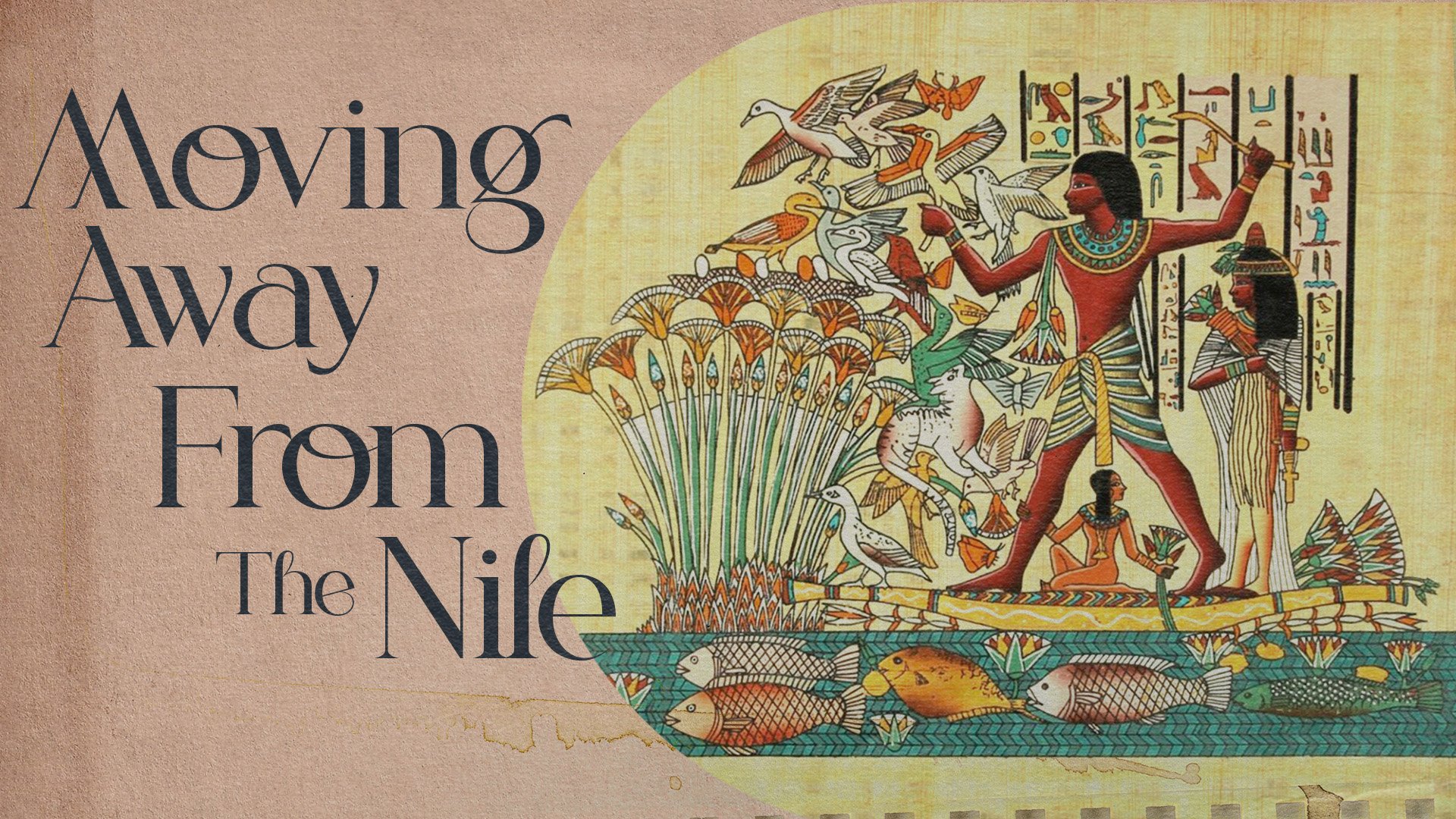
As the New Year takes off, many of us are trying out new things. We’re setting new goals, possibly transitioning jobs, re-evaluating our priorities, and hopefully checking our hearts to see where our allegiances lie.
In the midst of all of this, you might hear a recurring voice come up in your conscience, “Just make sure you keep trusting God amid those changes and transitions!” This is absolutely sound advice, but how exactly should that look? What does it mean to trust God when things change? Do we just pray, “Well God, I trust you.” Christian cliches, no matter how true, aren’t helpful when we don’t know how to apply them.
There’s a powerful moment during one of Israel’s transitions in the Old Testament that we can lean on to help us transition into new seasons: It’s in Deuteronomy 11,
You shall therefore keep every commandment which I am commanding you today, so that you may be strong and go in and take possession of the land into which you are about to cross to possess it… For the land, into which you are entering to possess it, is not like the land of Egypt from which you came, where you used to sow your seed and water it by your foot like a vegetable garden. But the land into which you are about to cross to possess it, a land of hills and valleys, drinks water from the rain of heaven, a land for which the Lord your God cares; the eyes of the Lord your God are continually on it, from the beginning even to the end of the year. (Deuteronomy 11:9-12)
Ancient Egypt was a civilization that developed along about 1000 miles of the Nile River. The Nile was both literally and figuratively the source and supply of stable agricultural life in Egypt. Ancient Egyptians worshiped the god Hapi specifically for providing consistent water from the Nile, and they used irrigation techniques that ran rising waters from the Nile into specific cisterns. So for Egypt, the Nile was both a literal source of provision and abundance, and it was a force worthy of worship and gratitude. Egyptian life was centered on trusting that gods would use the Nile to be their source and supply.
At this point in history, Israel had lived in Egypt for over 400 years. There is not a single living Hebrew who knows farming and agriculture in any other context other than how Egypt did it. Hebrews had no other choice but to center their lives on the systems Egypt used. If you did not at least acknowledge that some higher power faithfully provides using the Nile, you risk losing the health and wellness of your family. Worship and provision are intrinsically linked in the Bible, and they are linked for us today as well. As Christians, we are surrounded by people who believe, “You can follow God, yeah, but you have to participate in some secular rituals and practices in our society, otherwise you’re not going to make it.” That’s how it was for Israelites who saw consistent provision from Egypt, and now worried that they needed to take some of Egypt with them. They would pledge allegiance to Yahweh, sure, but it is only practical that they maintain some form of Egyptian ritual worship to be successful and provide for their families.
God saw this coming, and He prepared Israel by saying, “Hey, even the way you used to water your crops in Egypt, it doesn’t work like that here. I’m taking you to a new place in life where the water literally falls from the sky, and it does so consistently. Those irrigation techniques that you relied on in Egypt? Those won’t work for you anymore. New season, new strategy.”
As long as Israel tried to continue using Egypt’s method, they’d flounder in the new land, not realizing that what was provision for them in their former land is now depriving them in this new one.
Sometimes God brings change into our lives, and when He does, He removes physical sources of happiness and provision, because He knows that our trust and worship still reside in those sources. To bring us into a state of greater trust and deeper relationship with Him, and greater separation from the world’s solutions, He needs us to detach from former sources of supply and receive completely new ones: Sources that He personally governs in our lives. Deuteronomy 11:12 literally says that Israel is stepping into a land “for which the Lord your God cares.” Even though Israel tried to remain faithful to Worship God in Egypt, there was a form of acceptance that Egyptian powers governed their health and wellness. Egypt was their source and supply.
You used to receive your provision the way Egyptians did, and that was fine for a while, but the land into which you are going now—things don’t work that way.
As you dive into this new year, ask yourself if you’re trying to step into new territory while working and worshiping the way you did in the old places. If you are, pray and ask God to prepare your heart to let those go, so that your faith can accept this new land where things work differently, and God is truly your only source and your supply. It is okay to be grateful for the Nile in your past, and how God used it to get you through that season to prepare you for this one. God can use even the pagan practices of others to produce fruit from them for us. But perhaps it’s time to let those go.