The Hub of Christianity is in Africa
Christianity has always been a faith on the move.
It was born in Judea, quickly spread to Africa, Asia Minor, Central and Southeast Asia, and Europe, and, within centuries, established theological centers across the ancient world. Jerusalem, Antioch, Alexandria, Constantinople, Carthage, Caesarea, Edessa, the Tang Dynasty, Aksum, and Rome all became important centers of Christian thought and mission in their own ways.
Augustine was North African. Athanasius was Egyptian. Christianity flourished eastward through Syriac-speaking communities long before Northern Europe became predominantly Christian. Alexandria became one of Christianity’s great centers of biblical interpretation and theology, while Carthage helped shape Latin Christianity through figures like Tertullian, Cyprian, and Lactantius.
Long before Christianity became associated with Europe—or eventually with America—it was already a multicultural, multilingual movement crossing political boundaries.
Well, the center of Christianity is moving again.
As an American Christian, I’ve often fallen for the trope that Christianity is in “decline” in my lifetime, and that things keep getting somehow “less Christian” all around me. But this is often how Christians have felt historically when the faith is actually on the move and shifting its center.
When Alaric's Goths sacked Rome in 410 C.E., Jerome wrote that “the world sinks into ruin.” He didn’t think that was actually true, but that’s how things felt.
Augustine (good old Augie!) addressed this concern in his seminal work, City of God, by showing that locals had confused Rome with the kingdom of God; they are not the same thing. Rome is an earthly political society. The Church is the pilgrim City of God. They overlap. Christians participate in their societies, pursue peace, obey laws, and love their neighbors. But God’s kingdom is “a society of pilgrims of all languages,” and that city was on the move.
The Church moves through cultures, gathers people from them, and migrates when imperial power becomes the city's vice.
Picture Jesus saying,
When you enter any town, and they welcome you, eat the things set before you. Heal the sick who are there, and tell them, ‘The kingdom of God has come near you.’ When you enter any town, and they don’t welcome you, go out into its streets and say, ‘We are wiping off even the dust of your town that clings to our feet as a witness against you. Know this for certain: The kingdom of God has come near.’ - Luke 10:8-11
The people of the empire stopped welcoming the message of the kingdom of God, so the kingdom shakes off the dust and moves on.
The Center of Christianity Has Moved
For centuries, Europe appeared to be Christianity’s center of gravity. European Christians produced enormous theological traditions, built powerful institutions, and eventually sent missionaries around the world.
We’re seeing the global south step into those shoes now.
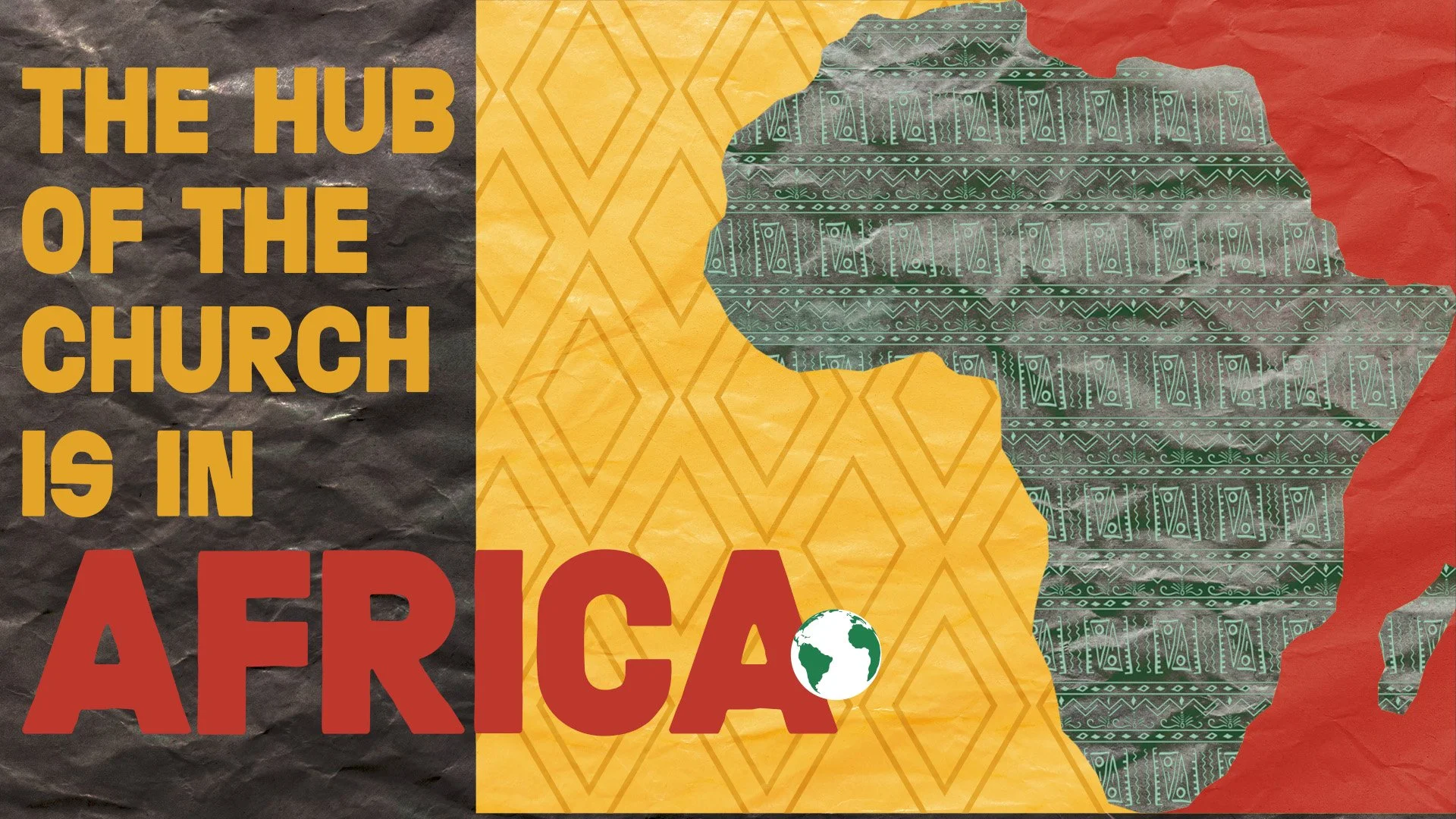
Pew Research Center's analysis of more than 2,700 censuses and surveys found that by 2020 sub-Saharan Africa had surpassed Europe as the region containing the largest number of Christians in the world.
Approximately 30.7 percent of the world's Christians now live in sub-Saharan Africa, compared with 22.3 percent in Europe. Another 24 percent live in Latin America and the Caribbean. Only about one in ten lives in North America.
That’s a wild and exciting shift!
In the early twentieth century, only about 1 percent of the world's Christians lived in sub-Saharan Africa, while roughly two-thirds lived in Europe. Today, nearly one-third live in sub-Saharan Africa. Between 2010 and 2020 alone, its Christian population grew to approximately 697 million—an increase of 31 percent.
For context, there are currently about 341.8 million people in the United States. There are twice as many Christians in sub-Saharan Africa as there are people in the US.
In one sense, Christianity's demographic center has come full circle toward one of its earliest heartlands. Not that Christianity belongs to Africa any more than it once belonged to Europe. Christianity has never really had just one center.
It moves.
There’s another interesting shift happening within cultural Christianity that I think ties into this movement.
Some younger Christians appear increasingly interested in expressions of Christianity that feel older, thicker, and less curated for modern Western culture.
I’m not trying to describe an exaggerated story about a massive Gen Z religious revival. America still has very high levels of religious disaffiliation among younger adults.
But Barna reported in September 2026 that 34 percent of adults ages 18–35 said they were attending church more frequently than they had a year earlier. Black and Hispanic young adults are among those reporting some of the largest increases.
Even more interesting is why they came back to church.
The most frequently selected reason was simply prayer. Forty-five percent identified prayer as a reason they attend church, ahead of every other spiritual motivation Barna measured.
Alongside this are visible pockets of interest in Orthodoxy, Catholic tradition, liturgy, the church calendar, Creedal theology, fasting, contemplative prayer, sacramental life, and other forms of embodied Christian practice.
Some young Christians seem hungry for a faith they did not invent. A faith received rather than curated. Faith capable of surviving elections, algorithms, influencers, or cultural crises.
And following that instinct very far creates an interesting problem for an overly Americanized Christianity.
The deeper you travel into Christian history, the harder it becomes to imagine Christianity as inherently American, or even inherently Western.
Our faith predates the United States by nearly eighteen centuries.
At the same time younger Christians are looking backward and discovering Christianity's ancient roots, global demographics are forcing us to look outward and discover Christianity's present diversity.
Both journeys lead toward the same conclusion: Christianity is moving. And Immigration speaks into this shift too.
Immigration is frequently discussed in American politics as though immigrants are entering a historically Christian civilization from somewhere outside the Christian world, but that assumption increasingly gets the geography of Christianity backward.
A Pew study of international migration estimated that 70 percent of migrants living in the United States were Christian, compared with approximately 64 percent of the overall American population in the comparable 2020 data. Only 13 percent of migrants were religiously unaffiliated.
Pew's conclusion was striking: migration has partially offset secularization in the United States.
During all of this, American Christianity itself is becoming increasingly multiethnic.
In 2007, non-Hispanic white Americans constituted approximately 70% of American Christians. By 2023–24, that had fallen to 61%, while the Hispanic and Asian portions of American Christianity had grown.
Follow me on some numbers here, because this is super interesting.
Pew's global migration analysis estimates that about 70% of migrants living in the United States identify as Christian, while roughly 64% of the overall U.S. population identified as Christian in 2020 data. Even more strikingly, 87% of migrants were religiously affiliated, compared with about 70% of the general U.S. population. Pew explicitly concluded that migration has “partially offset” the decline in America's religiously affiliated population.
Immigration is adding millions of people to America from populations that are disproportionately religious, and a majority of foreign-born Americans are Christian. Pew's 2023–24 survey finds 58% of foreign-born adults currently identify as Christians. Among immigrants born elsewhere in the Americas, 72% are Christian.
And there is evidence that some immigrant Christian populations exhibit unusually high religious commitment. Pew's research on Latinos, for example, found foreign-born Hispanic mainline Protestants dramatically more likely to say religion was very important and to attend weekly than U.S.-born Hispanic mainline Protestants—59% versus 18% weekly attendance in that earlier study. Research on Asian Americans similarly found immigrant Protestants and Catholics more likely to attend weekly than their U.S.-born counterparts.
That means immigration is doing more than changing the racial makeup of the Christian label. In at least some communities, it is importing active faithful Christians and their practices.
One more really important data piece to notice, and I’ll get back to Africa.
Immigration is helping sustain American religious life, but America might be secularizing immigrants.
Pew finds that among foreign-born adults, Christian identification fell from 75% in 2007 to 58% in 2023–24, while religious unaffiliation rose from 16% to 26%.
An older longitudinal study of new immigrants found something even more provocative. Among Christian immigrants, reported weekly attendance fell from 56% before migration to 27% after arriving in the United States. Protestant immigrants retained participation better than Catholics in that study, but the overall decline was striking. The researchers noted that practical factors such as access to the church style of their choice could explain part of the drop.
An American whose grandparents were Methodist may now simply identify as “none.”
Meanwhile, a Nigerian immigrant, Guatemalan Pentecostal, Brazilian evangelical, Filipino Catholic, Egyptian Coptic, or Korean Presbyterian may hit our shores, carrying a Christianity that has little investment in America's old Protestant cultural establishment, but may be intensely Christian nonetheless.
So American cultural Christianity can shrink while the actual practicing Church thrives and becomes more visibly global.
Many people arriving in America come from precisely the regions where Christianity is most vibrant and numerous.
The missionary movement no longer travels in one direction.
The nations once receiving missionaries from Europe and North America now send pastors, church planters, theologians, families, and missionaries back into the Western world. The global Church is becoming our neighbor.
None of this resolves the American immigration-policy debate. Nations still wrestle with questions involving borders, law, asylum, citizenship, economics, and governmental responsibility. Demographic statistics don’t tell Christians exactly what immigration policy should look like.
But they can expose a category mistake: Christians should be cautious whenever cultural change is described as though it were Christian decline. Those are two different things.
If Christianity becomes too closely intertwined with a particular ethnicity, political coalition, or cultural identity, then shifts in that culture can start to feel threatening.
All of the sudden we aren't afraid that America is changing; we’re afraid Christianity is disappearing.
But some of the people changing America are Christians, and they speak Spanish, Korean, Arabic, Amharic, Yoruba, and Portuguese.
Some worship differently than we do, bring unfamiliar traditions, and understand the Christian life through cultures formed far away from American evangelicalism.
By the way, none of this boils down to immigration policy or cultural isolation: These are ecclesiological questions.
Revelation imagines the culmination of God's redemptive work as a multitude from every nation, tribe, people, and language gathered before Christ. The multiethnic Church isn’t a modern concession Christianity makes to diversity. It’s where the biblical story has been heading all along.
Christianity Keeps Moving
I think it’s time for an updated map. Christianity began on the eastern edge of the Roman Empire. It moved through Jerusalem and Antioch. It took deep root in Egypt and North Africa. It traveled east through Syriac Christianity and west through Rome. Its institutions eventually became deeply identified with Europe. Europeans carried Christianity across oceans. And now Christianity's demographic center has shifted dramatically toward Africa, Latin America, and other parts of the Global South, while Christians from those regions migrate back into Western nations.
The story never moved in a straight line. Christianity keeps crossing borders.
The alternative to an America-centered Christianity is not an Africa-centered Christianity, an East-Asian-centered Christianity, or another version of Christian nationalism imported from somewhere else. It is something much older and much, much larger:
Christ at the center, surrounded by a Church from every nation. This is one of the gifts immigration can offer American Christianity.
I don’t care about Christians improving demographics to boost my morale. I care about something a lot more important. The Church was never mine to begin with. Christianity existed before me. It is flourishing far beyond me. And whatever comes next in the story of the global Church, God is driving it through the witness of the Spirit.
What a freeing thought!