Why It’s Okay to Practice the Way
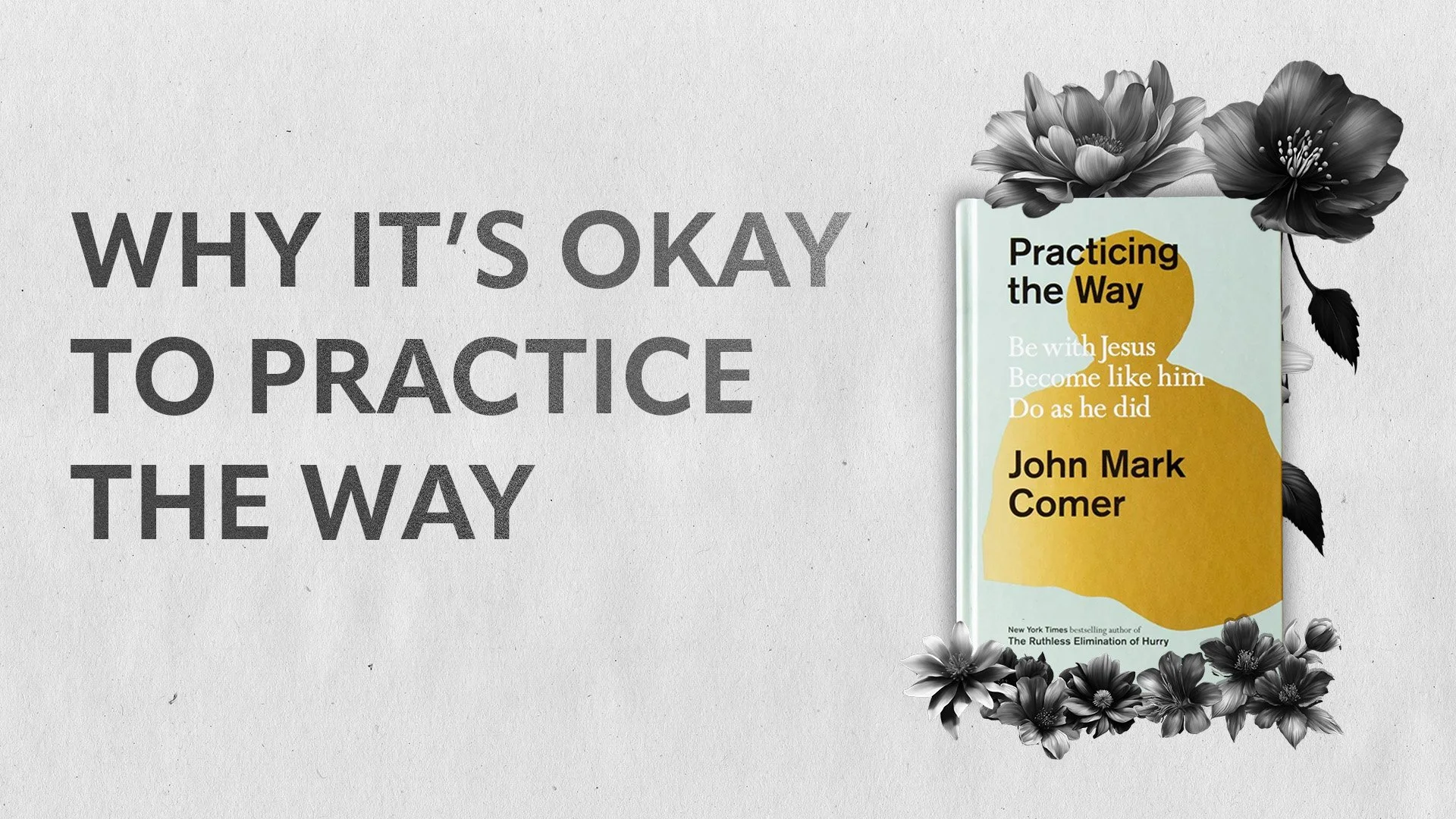
This article is my response to a review Kevin DeYoung published online for John Mark Comer’s Practicing the Way, a book Comer released in January of 2024. It must be stated that I am not writing this response because I expect Kevin DeYoung to grapple with it. He is a known Reformed Scholar and established author, and I’m no one of note. He will never see this. I am addressing DeYoung’s review because numerous people have approached me in the last year with serious concerns about Comer’s book, and most of their concerns reflect a theological leaning that authors like DeYoung often influence. After speaking to so many people about my thoughts on Comer and Practicing the Way, it would be easier for me at this point to write my thoughts down and share them with anyone who has questions in this format. When people bring their concerns to me about Comer, and I ask them what sources they use to confirm their concerns, they often send me video links to fundamentalist Protestant YouTube pastors. I’m choosing to respond to DeYoung’s article instead because he is a known, credible, influential scholar, and I respect his message and ministry. I also think he articulates his concerns about Comer’s work well, and he’s gracious in his criticism. The flow of this article follows Kevin DeYoung’s critique of Comer’s work. I do not hold all the same theological views as DeYoung, nor do I identify with the Reformed tradition, so many of my critiques of DeYoung’s review will be based on these differences. One thing I truly appreciated about DeYoung’s review is that he acknowledges the faith traditions that influence Comer beyond his own. He warns his readers about these differences right away. His main aim, he claims, is to speak to people who value Reformed theology and to help them recognize the concerns he sees in the book.
My response to DeYoung’s review is extended. Yet I still did not have the space to grapple with every aspect of his concerns and challenges fully. I hope you find my assessment of his review helpful and that it explains why I continue to support Comer’s work and “practice the way.”
The Way?
DeYoung’s first two concerns are that Comer spends a significant amount of time discussing how “The Way” in the Book of Acts of the Apostles and “discipleship” refer to a spiritual and ethical method for following Jesus, thereby minimizing what reformed Protestant church traditions prioritize. DeYoung mentions specifically repentance, receiving the good news of the gospel, and the Reformed soteriological (salvation) implications of this (going to heaven and avoiding hell/God’s wrath). DeYoung believes this language will lead people to an understanding of the gospel that focuses more on how Jesus lived and less on what Jesus did to save souls from sin.
The early Christians were called followers of the Way, not first of all because they were apprentices to Jesus trying to do what he did, but because they believed Jesus was the long-awaited Christ and that in his name, and in his name alone, men might be saved.
First and foremost, I respect DeYoung’s concerns. Jesus is absolutely more than a model for human behavior. He defeated the powers of sin and darkness and overcame the greatest weapon of evil (death) with his resurrection. If Jesus were only a model, we’d all still be slaves to sin. Of course, no one who promotes the Contemplative Tradition believes Jesus was only a model.
That being said, I want to discuss what the word “saved” means. Nearly 40% of the New Testament (NT) consists of teaching principles that instructed first-century followers of Jesus on how to live. Scholars who study Greco-Roman letter structure and biblical rhetoric often divide NT writings into two main sections: Indicative (what God has done in Christ; proclamation, doctrine, theology), and Imperative (how we are called to live in response; ethics, lifestyle, exhortation)
While these categories often blend, here are some estimates: In Paul’s Letters (about 30% of the NT): Around 40–50% are exhortation/commands (Romans 12–15, Ephesians 4–6, Colossians 3–4). The rest may be considered theology, narrative, or prayer. For example, Romans 1–11 is almost entirely theology, while Romans 12–16 is almost entirely about living faithfully. In the Gospels (about 45% of the NT), Jesus’ teaching (Sermon on the Mount, parables, kingdom ethics) takes up a significant portion, perhaps 30–40% of Gospel content, which is moral/ethical instruction. The rest is a narrative about who Jesus is, what he did, and his death and resurrection. General Epistles & Revelation (about 25% of the NT): Books like James, 1 Peter, and 1 John are heavily ethical/exhortational. James is 60% about how to live. Revelation is more apocalyptic, but still calls the churches to endurance and faithfulness (25–30% exhortation). The point is that scripture gives ample attention to how Christians should live and ample instruction on how to imitate Jesus. Explicitly, John 13:13-14, Philippians 2:5-8, 1 Peter 2:21, Ephesians 5:1-2, Colossians 3:13, 1 John 2:6, and a host of others. Jesus as a model is not an antithetical theological framework to Jesus as an atonement for the penitent. DeYoung is concerned that people will find more ethical value in Jesus than soteriological. But these two concepts are not in opposition to each other. In fact, based on the entire Jewish Rabbinic tradition common to the first-century church with talmidim (disciples) and their rabbi (teacher) (Comer explains them to modern readers as “apprentices” to make the concept of discipleship more digestible to a contemporary audience), the New Testament clearly has a lot of dependence on Comer’s understanding of these instructions. Let’s look at some:
Matthew 4:19; Mark 1:17; Luke 5:27
In first-century Judaism, “follow me” was a technical phrase.
To follow a rabbi meant to: attach yourself to him, to live with and learn from him, to imitate his halakhah — his interpretation of how to live the Torah.
“Take my yoke upon you and learn from me.” A rabbi’s “yoke” meant his teaching, his way of interpreting Torah, and the lifestyle he required of disciples.
“Learn from me” (mathete ap’ emou) is literally discipleship language.
Jesus is presenting Himself as a rabbi offering His yoke, one that brings rest rather than burden.
“A disciple is not above his teacher, but everyone when fully trained will be like his teacher.”
This is pure rabbinic logic.
The goal of discipleship was not only to learn knowledge but to become the kind of person your rabbi is; to “be like” him in practice and character.
“Be imitators of me, as I am of Christ.”
Ancient disciples were expected to imitate their rabbi in speech, conduct, piety, mannerisms, priorities, and ways of interacting. Paul uses mimetic language (μιμηταί), a core feature of Greco-Roman and rabbinic education, to describe Christian formation.
“… he ought to walk in the same way in which he walked.”
This is the most explicit rabbinic-style imitation command in the NT. “Walking” (halak in Hebrew) is the root of halakhah — the rabbi’s way of life. John tells believers to follow Jesus' halakhah. That’s unmistakably rabbinic.
DeYoung does not fully articulate what repentance and salvation are in his critique, so I cannot quote him here. Still, my best brief explanation of Reformed soteriology is this: In the Reformed Protestant tradition, “salvation” means that God graciously justifies sinners by imputing Christ’s righteousness to them through faith alone, delivering them from sin’s guilt and wrath in hell, and securing their eternal reconciliation with Him. That’s what it means to be “saved.” Here’s my larger disagreement with DeYoung’s concerns in this critique, and here is my key disagreement with reformed scholarship in general: What did the gospel of Jesus Christ actually save people from? What is “the way of salvation?” If it’s the wrath of God and eternal torment in hell only, then I, along with a host of Biblical Scholars, would argue that this wasn’t good news to most of the Roman Empire at the time the Church began. It is a dualistic, platonic, and frankly, semi-Gnostic understanding of the universe to claim that God’s wrath against sin and eternal separation from God are the only things God restored through Christ’s passion and resurrection as prophesied in Isaiah 40:3. Here’s an extremely brief overview of the numerous, rich, theologically sound, and ancient understandings of what Christ accomplished in the thoughts of New Testament believers according to scripture:
1. Victory over Satan and Demonic Powers
Genesis 3:15 – The “protoevangelium”: the seed of the woman will crush the serpent’s head.
Colossians 2:13-15 – “He disarmed the rulers and authorities and put them to open shame, by triumphing over them in him.”
Hebrews 2:14–15 – Jesus shares in flesh and blood “that through death he might destroy the one who has the power of death, that is, the devil, and deliver all those who through fear of death were subject to lifelong slavery.”
1 John 3:8 – “The reason the Son of God appeared was to destroy the works of the devil.”
2. Liberation and Deliverance
Exodus Typology (Exod. 12–15) – Israel’s liberation from Egypt functions as a pattern of God defeating oppressive powers through redemption. The NT echoes this pattern in its description of Christ’s work.
Luke 4:18–19 – Jesus’ inaugural sermon: “The Spirit of the Lord is upon me… he has sent me to proclaim liberty to the captives…”
3. Triumph of Self-Giving Love
John 12:31–32 – “Now is the judgment of this world; now will the ruler of this world be cast out. And I, when I am lifted up from the earth, will draw all people to myself.”
Romans 5:18–19 – By one man’s obedience, many will be made righteous; a restorative, life-giving victory over Adam’s curse.
4. New Creation & Cosmic Renewal
Romans 8:19–21 – Creation waits with eager longing for liberation from bondage to corruption.
2 Corinthians 5:17 – “If anyone is in Christ, he is a new creation.”
Revelation 21:1–5 – New heavens and new earth, death defeated, all things made new.
These scriptures receive profound elaboration from scholars such as Greg Boyd, Joel B. Green, N.T. Wright, Michael Gorman, John Barclay, Fleming Rutledge, Gustaf Aulén, and a grand host of others who have spent their careers exploring the ramifications of Christ’s death and resurrection and the language of the early church regarding it. They uniformly agree that the good news of the gospel was actual, physical good news to a world in slavery to the empire, suffering under discrimination, and death at the hands of extreme violence. The way of life was liberated from the tyranny of both imperial and demonic institutions, so that humans could recover the vocation of worshiping God and stewarding His good creation in their daily lives.
Clearly, I believe in a salvation message that has soteriological implications beyond the Reformed emphasis (Penal Substitutionary atonement). Past this simple nuance in DeYoung’s theology and my own, however, lies my greater conern with critics of Practicing the Way: This notion that you are a wretched sinner who is only able to grow in God’s grace (if I’m even allowed to say “grow” to my Protestant friends) is an idea put forth firmly by every Southern Baptist, Methodist, Presbyterian, and all around Protestant church within the tradition. The message is that if you can embrace the reality that only God’s Spirit can awaken grace in you and reach this paramount mental ascent about God’s grace (that you better take no credit for), you’ll suddenly want to be a “better Christian.” And to all of that I say, “Yes. Amen! Only God can turn the heart. Only by His grace.”
And yet those denominations are bleeding congregants and starving for what to do after this awakened experience. The modern-day Protestant church has risked abandoning discipleship for fear of almost discussing works within the Christian life.
And when the church doesn’t disciple, someone or something else will. Phones and influencers and cultic pop-thought and politics and people with TikTok doctorates are discipling the Protestant church. The 5 Solas of the Reformation are not discipling the Protestant church. The solas are beautiful. They are a gift. They are a symphony in a world of flat noise. But they are an incomplete expression of the gospel as a whole. They are a minuet: the gospel is a symphony, and discipleship and spiritual formation make up some of the missing pieces of the music. This is why Generation Z is flocking to Comer’s work. It isn’t because they’re young and easily led astray by esotericism. That’s often the criticism of younger generations: that they’re cowards who want a watered-down gospel, so they focus on TED Talk instructions rather than hard biblical truths. But studies show young people are the opposite: They’re pursuing strict, rigid, embodied faith, tired of the free-market therapeutic deism of their parents and grandparents. The next generation wants a faith that isn’t Gnostic. They want a faith that is grounded in the physical world, embodied in authentic experiences, and recaptured as tangible hope in a broken world. That means they want discipleship and spiritual formation, not a distant promise that they skipped hell and made it to some wispy spiritual heaven someday after they’re done enduring discipleship on earth by everything that isn’t Jesus.
Lifestyle Discipleship
Continuing DeYoung’s concerns over discipleship language within scripture, he challenges Comer’s use of John 14:6 as a paradigm for following Jesus, which Comer says is “the marriage of his truth (his teaching) and his way (his lifestyle) is how to get to the with-God life he offers.”
“[Comer’s] novel interpretation fails to take into account the context of John 14, which is about believing in Jesus (14:1), and about how to go to the “place” that Jesus prepares for the disciples (14:2–4), and about how they come to know the Father (14:6), and about how they see the Father (14:9), and about how they too can go to the Father (14:12). Comer’s interpretation ignores all this and makes Jesus’s statement about his lifestyle.”
This is a typical disagreement between reformed scholars and scholars within broader traditions. The disagreement is fundamentally about what the gospel is.
The early church usually held that being “in Christ” involved both trusting him and entering into an obedient, formed way of life (baptism, prayer, repentance, virtues, the life of the community/ascetic practice). The “gospel” is not primarily a message about how individuals go to heaven, but rather the announcement that Jesus of Nazareth is Lord, the true King of the world, and that through him, God’s long-awaited kingdom has been inaugurated on earth as in heaven. Sin, death, and evil have been defeated through the cross and resurrection. Those who trust and follow Jesus become part of this renewed creation and join in God’s mission to restore the world (Isa. 42:7; Mark 1:14-15; Rom. 1:1-4; 1st Cor. 15:1-8; Phil. 2:9-11; cf. Isa. 45:23). This is not a “novel interpretation” as DeYoung calls it, but a historical approach to what it means to put your pistis (faith) in Jesus. Justin Martyr (First Apology, Dialogue with Trypho) taught that Christians are saved not by profession alone but by living according to the Logos (Christ). Irenaeus of Lyons (Against Heresies, Demonstration of the Apostolic Preaching) believed Jesus saves not only by dying but by living in perfect obedience and inviting believers into that same obedient pattern. He writes that believers must be “conformed to the image of the Son,” sharing in his obedience to the Father. Origen, Basil the Great, Clement of Alexandria, John Chrysostom, and several others believed that repentance and faith included allegiance and obedience. Those are easily synonyms for “practicing the way.”
Again, this does not mean that the gospel is only a model of obedience and lifestyle, and that is a valid point DeYoung emphasizes. Still, we certainly shouldn’t exclude those basic elements of human life and free will when we look at what the good news of salvation is. It is freedom to obey Christ and walk with Him intimately for eternity, and the powers of sin and darkness can’t stop you.
Another primary issue at play for DeYoung is Comer’s interpretation of the “Narrow Gate” in the Sermon on the Mount:
Instead of embracing the traditional understanding of Jesus’s words, Comer finds a different interpretation “more compelling,” namely that if you walk in the broad way of the majority culture, your life will fall to pieces, “never reaching your promise or potential” (27). I’d say “never reaching your promise or potential” is a pretty soft sell on the word “destruction,” especially when the context is clearly eschatological. Jesus is not simply talking about a dysfunctional life falling to pieces because of our poor choices. He is talking about “workers of lawlessness” who will be condemned by him on the day of judgment (Matt. 7:23). I don’t know what Comer believes about judgment and hell, but he often goes out of his way to explain away notions of divine wrath and punishment.
Calling the “Narrow Gate” a pathway to heaven and its opposite a path to hell is, in fact, not a traditional reading of the text. In Second Temple Judaism, “the way” (Heb. derek, Greek hodos) was standard moral/ethical language. Psalm 1 contrasts “the way of the righteous” vs. “the way of the wicked.” The entire Psalms corpus is introduced as a method of living within the covenant mercy of God by choosing to obey God’s instructions in a discipled life. The Qumran community (the Dead Sea Scrolls) used “the Way” to describe their distinct lifestyle and teachings. Second Temple rabbis contrasted the “narrow path” of wisdom vs the “broad path” of folly. Jesus is using well-known Jewish metaphorical language: choosing a teacher, a way of life, a halakhah. This background points heavily toward discipleship rather than afterlife destinations. Jesus is saying: Choose the difficult, disciplined way of life I’m teaching you, not the easy, destructive path offered by other teachers.
The Didache, one of the earliest Christian writings outside the New Testament, begins with: “There are two ways, one of life and one of death.” (Didache 1.1) This is explicitly about ethical lifestyle and discipleship, not heaven/hell. The Didache often addresses humility, generosity, forgiveness, sexual purity, and non-retaliation. The “way of life” is essentially the Sermon on the Mount lived out. The earliest Christian interpretation treats “the two ways” as a way-of-life teaching. Writers like Barnabas, Hermas, and Polycarp also use “two ways” language to describe moral formation and obedience, not afterlife judgment. Barnabas 18–20: Two ways: one of light, one of darkness.
Hermas, Mandate 6: Two ways: truth vs. evil.
Again: This is discipleship, not eternal destinies. It is somewhat liberal to solely view the gate passage in the Sermon on the Mount as eternal destinies concerning God’s forgiveness and judgment.
To be clear, I don’t think DeYoung’s position or Comer’s is opposed to the other here. Following Jesus means committing to follow him for eternity, starting now. That means spending eternity with God, restored to creation’s original design as an image bearer, which would include being with Jesus in the New Creation when God restores all things (a.k.a the gospel). To choose another rabbi (any other path than Jesus) is to walk a path that leads to destruction both immediately and for eternity, regardless of one’s view of hell (which was also very diverse before Reformation theology).
On Grace and Salvation
A significant concern for DeYoung is that Comer’s book puts worshiping Jesus “in the background” and following Jesus “in the foreground.” Yet there is an endless amount of literature highlighting the Protestant tradition that salvation is bound up in the acknowledgement that Jesus is Lord and King of the universe, and that one day every knee will bow to him. But there is so little solid, Protestant literature on how to align your life with the kingdom of God and to steward God’s good creation well, which the entire gospel seeks to restore. I wholeheartedly agree with DeYoung that the gospel can never be truly understood without the lordship, Spiritual infilling, and saving grace of Jesus in the believer's life. But Comer doesn’t seem to be trying to re-explain any of that in a book that is primarily about discipleship. I suppose he could have made the book three times as long and rehashed the entire gospel narrative (though he wouldn’t have done so from a monergistic point of view, since he isn’t Reformed). Still, then the book would have been another theology book revisiting Augustine and Pelagius. Half the readers would have put it down, and Christians would have continued to claim Jesus is lord with their mouth while being discipled by their phones and politicians in practice.
The primary concerns in this section of DeYoung’s argument stem from a significant historical moment that needs to be addressed for clarity and context. Martin Luther and what became known as the Protestant Reformation sought to answer a specific question that was plaguing Europe and harming the laity through clerical abuse in the Roman Catholic Church: How are people “in” and how are they “out?” Who gets to go to heaven and who goes to hell? Does the Church get to decide? And if so, who speaks for the Church? What is the true efficacy of indulgences? Can we truly spend money on the Pope’s program to build a cathedral and save our family from purgatory? The Reformers wanted to address this central historical question to save people from spiritual abuse, which is why almost all Reformed theology focuses on Romans and on Penal Substitutionary Atonement language when talking about God, salvation, and eternity. But if Luther had discovered the riches of Ephesians before he dove into Romans, he would have walked away with a very different approach to answering this question, and all of Western Christianity would look very different today. Ephesians is all about creation and new creation, and how God seeks to redeem it all back to his original good purpose. There’s little to no mention of people being “in” or “out,” or at what moment or by what force a person is “saved” in the New Testament at all, but that framework is actually impossible to detect in the letter to the Ephesians. As DeYoung kindly mentioned at the beginning of his critique, he is approaching this conversation from a Reformed perspective, so I don’t expect him to respond differently here. My primary concern lies in the lack of resources available to present-day Protestants regarding historic discipleship, and in how Reformation theology, apart from robust systematic dogmatics, has not addressed this issue, beyond telling Christians to pray and read their Bibles more.
Ancient or Modern?
Deyoung’s third concern is that Comer desires to position his book into the ancient practices of the early church and the desert fathers and mothers, right up through the Reformation. He says that, despite Comer’s attempts, “Comer’s project is tailored to twenty-first-century, secular-leaning sensibilities.” When discussing the Benedictine Rule, a concept Comer leans on heavily in Practicing the Way, DeYoung argues,
The problem with Comer’s historical reconstruction… is that the vibe of Comer’s rule is nothing like the vibe of Benedict’s Rule. On one level, of course, this is not a problem. Benedict doesn’t have a trademark on the word “Rule.” Comer can call his set of spiritual practices whatever he wants. But readers should not think they are adopting something ancient, when actually they are adopting something new.
DeYoung further positions Comer’s work within modernity by framing it as a self-guided practice distinct from historically strict monastic practices, rather than the rigorous and often harsh (punishment-inflicting) life of the monastery.
[Comer] stresses that the Rule is not a law. The difference: “A law is handed down from an external source, and it has very little flexibility. By contrast, a rule is self-generated from your internal desires, it has a ton of flexibility, it’s relationally based (not morally based), and it’s designed to index you toward your vision of the good life.” I applaud Comer for encouraging us to be intentional in our spiritual formation and to come up with a plan for following Jesus. But a self-generated, flexible, not morally based vision of the good life that enables us to fulfill our deepest desires is not quite what Benedict had in mind.
I will again point out that this is a wonderful concern from DeYoung. Self-help strategies are antithetical to the gospel and should be held in contempt with every gnostic and legalistic heresy Paul preached against time and time again (Gal. 1:8-9). However, two things should be considered here. First, Comer has already emphasized earlier in this particular work that grace alone saves and that the Holy Spirit guides all acts of sanctification (116). DeYoung acknowledges this in his critique. Again, the point of this book is to focus on spiritual formation, not the implications of Penal Substitutionary Atonement. I don’t believe Comer is suggesting that spiritual maturity is an inner journey in which you follow your heart and set your own standards. This is really the first time in DeYoung’s critique that he uses a straw-man argument against Comer and stretches the argument a bit. Comer’s entire framework is that the monastic tradition (of which Luther and many reformers were a part) is rooted in a rabbinic tradition, which shares soil with all of second temple Judaism and the New Testament. That tradition states that all disciples everywhere, whether pagan, Jewish, or eventually Christian, trained themselves to be disciplined in spiritual practices, and that these disciplines have been lost in the modern West. This is something Luther, Zwingli, Melanchthon, Knox, Bucer, Calvin, d’Albret, and others took for granted and rarely taught because it was already assumed in their world. In the sixteenth century, no one participated in any valuable religion or philosophy without training themselves to be dedicated to it. Comer isn’t instructing people to follow their own compass; he’s teaching many modern spiritualists something they’ve never heard before—that you actually have to do the thing you value, not just say you believe it.
Second, DeYoung’s reliance on the spiritual authority, hierarchy, and, at times, painfully strict way of life in the monastery misses a significant shift in the global West since the Enlightenment: Individual liberty and the inalienable self-worth of all mankind have completely reappropriated how spiritual practices are applied to people today. Of course, ancient churches and monasteries were strict, authoritative, and disciplinary: The entire underpinnings of the ancient world operated in rigid, systematic hierarchies. But if a spiritual family forced rules and inflicted discipline on a congregant member today, we wouldn’t call that a church; we would call it a cult. Every single person in the Western Hemisphere now operates their life of faith through their own lens of belief and personal dedication. That isn’t the same as self-revelation or being one’s own lord and savior. That is simply an acknowledgement that we live in the twenty-first century. The Reformed Church today creates wonderful catechisms and resources for families precisely for this reason: they want to guide and encourage Christians to practice their faith in a way that they themselves must structure and commit their family to, without fear of disciplinary action. To use this sort of comparison between Comer’s approach and the Benedictine Rule seems obtuse to me, and I think DeYoung should clarify this concern further.
The Centrality of Scripture
Lastly, DeYoung brings up what I would argue is the best concern in his pushback on Comer’s work. He states that Comer's “approach to spiritual formation undermines the uniqueness of God’s word by making Scripture just one of many pathways to God.”Citing Comer’s work, DeYoung explains,
Comer argues that anything can be offered to God as a channel of grace. Think about that. Does God really minister his grace through everything? Comer gives several examples: walking your dog, taking a spin class, visiting an elderly neighbor, driving in the slow lane, reading philosophy, writing a proof for physics. He says, “you can offer any of these activities to God in hope that he will fill those spaces with his transforming presence.” But these experiences—no matter how enjoyable or beneficial—are not means of grace in themselves.
I’m glad DeYoung brought this point up. Comer would have been wise to preface his hermeneutic when using terms saturated with soteriological implications, such as “grace.” He could have spent only half a page elaborating ever so briefly on the abundant semantic meanings of charis (grace) depending on its context. DeYoung is aware of these semantics, and though he doesn’t elaborate on the point further, he undoubtedly knows that Comer does not believe any of the acts described above are forms of grace that carry an unmerited saving component. For anyone reading this who may not be aware of what I am talking about, I will give the briefest explanation, one that certainly can’t do this topic justice. Still, I will hopefully explain something scholars often discuss: what charis (grace) is and how the term operates in relationships in the New Testament.
Charis in Paul carries multiple meanings, and “unmerited favor” is only one dimension, not the word’s definition. In the Greco-Roman world, charis meant “gift,” “favor,” or “generosity,” often given in exchange for worth and with the expectation of reciprocity. Paul reshapes this concept by highlighting its incongruity—God gives to the unworthy (Rom. 5:6–8; Eph 2:1–9)—but he also uses charis for divine empowerment (1 Cor. 15:10), apostolic calling (Gal. 1:15), ministry gifts (Rom. 12:6), gratitude (1 Cor. 1:4), and the overall economy of God’s kindness (Titus 2:11). Paul perfects certain aspects of grace (priority, incongruity, efficacy) without making “unmerited favor” the definition. Thus, charis is richer and more varied than the narrow sense often assumed. In the ancient Mediterranean gift economy, a charis (gift) was usually given within a relationship of reciprocity, took the recipient's worth into account, and was expected to be met with gratitude (“gift and gratitude”). Within this framework, grace and gifts (both charis) are good things created by God, placed within the believer to be used (operated out of) for God’s glory as the believer dwells with God in His presence. This is precisely how Comer uses the term. There is no efficacy for salvation by means of grace in this conversation at all. Salvation may be by grace alone, but grace does not belong to salvation alone.
Another sticking point for DeYoung is how Comer utilizes the concept of “abiding” in Jesus in the gospel of John,
Comer teaches that the way to be with Jesus is to abide in Jesus. He notes that “abide” translates the Greek word meno, which is used ten times in John 15. According to Comer, when Jesus says “abide in me,” he is saying, “Make your home in my presence by the Spirit, and never leave” (37). Being an apprentice of Jesus is about letting your body become God’s home. Jesus calls this abiding (39).
In response, DeYoung takes an entirely different exegetical approach than Comer,
But that’s not what Jesus means by abiding in him. In John 15:7, Jesus uses two concepts interchangeably: abiding in him and his words abiding in us. Jesus is with us when his word is with us, and we are in him when his words are in us. There is an intimate connection between the person of the Word of God and the words of God in speech and in Scripture. The eternal Logos is the mediating agent in creation, in redemption, and in revelation, whether by means of the word spoken (and later written down) or by means of the Word made flesh.
I appreciate this concern greatly. Scripture is the most wonderfully preserved and beautifully disclosed summation of God’s faithful proclamation to be the Creator and Sustainer of all things; things that He Himself will redeem and renew at the consummation of His kingdom in the New Creation at the end of the Age. DeYoung follows in the footsteps of the Reformed tradition by defending the sacred authority of scripture, and he rightly contends that Comer makes little to no mention of this in his work. While I see no problem with Comer’s exegesis, it would again have been wise for Comer to include some sense of his hermeneutic when using such popular scriptures in a manner many protestants have never seen before.
Where I disagree with DeYoung is his proposal that the Logos (λόγος), as the written word, is the key to abiding in Jesus. This is a common issue I hold in general within Western Christianity. Scripture is beautiful, and it is the highest authority in the life of the believer, but it is not Jesus. It speaks of Jesus, reveals Jesus, and upholds the perfect revelation of the Godhead until the inauguration of God’s kingdom. But in the gospel of John, Jesus replaces via fulfillment the temple (2:19-21), Passover (1:29, 19:36, 6:1-50), Tabernacles (7:37-39, 8:12), Hanukkah (10:22-30), the purity system (2:1-11, 13:8-10), the traditions of the patriarchs (4:12-14), Moses and the Torah (1:14-18, 5:39-47, 6:32-35) and the holy land of Israel (1:51, 4:20-24, 15:1-8; cf Is. 5). You could argue that by fulfilling the Torah, we abide with Jesus within scripture, but that’s a very reductionist approach to the theological perogative of John’s gospel. It misses Comer’s point entirely anyway: The goal of being immersed in scripture is to be with Jesus. The goal of everything within the salvation arc of scripture and history is to be with Jesus. David did this, as did Moses, the disciples, and the Apostle Paul. While I believe that scripture is entirely God’s word and that it carries God’s authority, I tread more carefully than DeYoung in assuming that scripture itself is a 1:1 form of the Logos John describes in his gospel. DeYoung does not outright say this, but he implies that Comer is not saying it, and fits the absence of such an approach into his critique of Comer.
Conclusion
DeYoung's critique of John Mark Comer’s Practicing the Way raises legitimate concerns from a Reformed perspective, particularly regarding the primacy of soteriology, the authority of Scripture, and traditional interpretations of salvation and judgment. Yet, when viewed through the lens of first-century Judaism, Greco-Roman letter structure, and the broader early church tradition, Comer’s emphasis on discipleship, imitation of Christ, and spiritual formation is neither novel nor contrary to the gospel. Instead, it reflects an integrated understanding of salvation as both gift and lived reality, where grace initiates and sustains life in Christ, and obedience, imitation, and spiritual practices shape believers into the image of the Son. By situating his work within historical practices, rabbinic pedagogy, and contemporary cultural realities, Comer addresses a persistent gap in modern Protestant discipleship: the cultivation of embodied, practical faith that engages both the mind and the life of the believer. Ultimately, the tension between Reformed soteriological precision and Comer’s holistic formation approach illuminates a broader question for the church today: how to faithfully convey the fullness of the gospel as both good news of redemption and a transformative way of life in the world.