
I like to share my thoughts on theological and philosophical topics. I am also a student working through an MDiv and occasionally share papers on the blog. If you have any questions on a paper or blog post, send me a message! I’d love to talk with you about it.
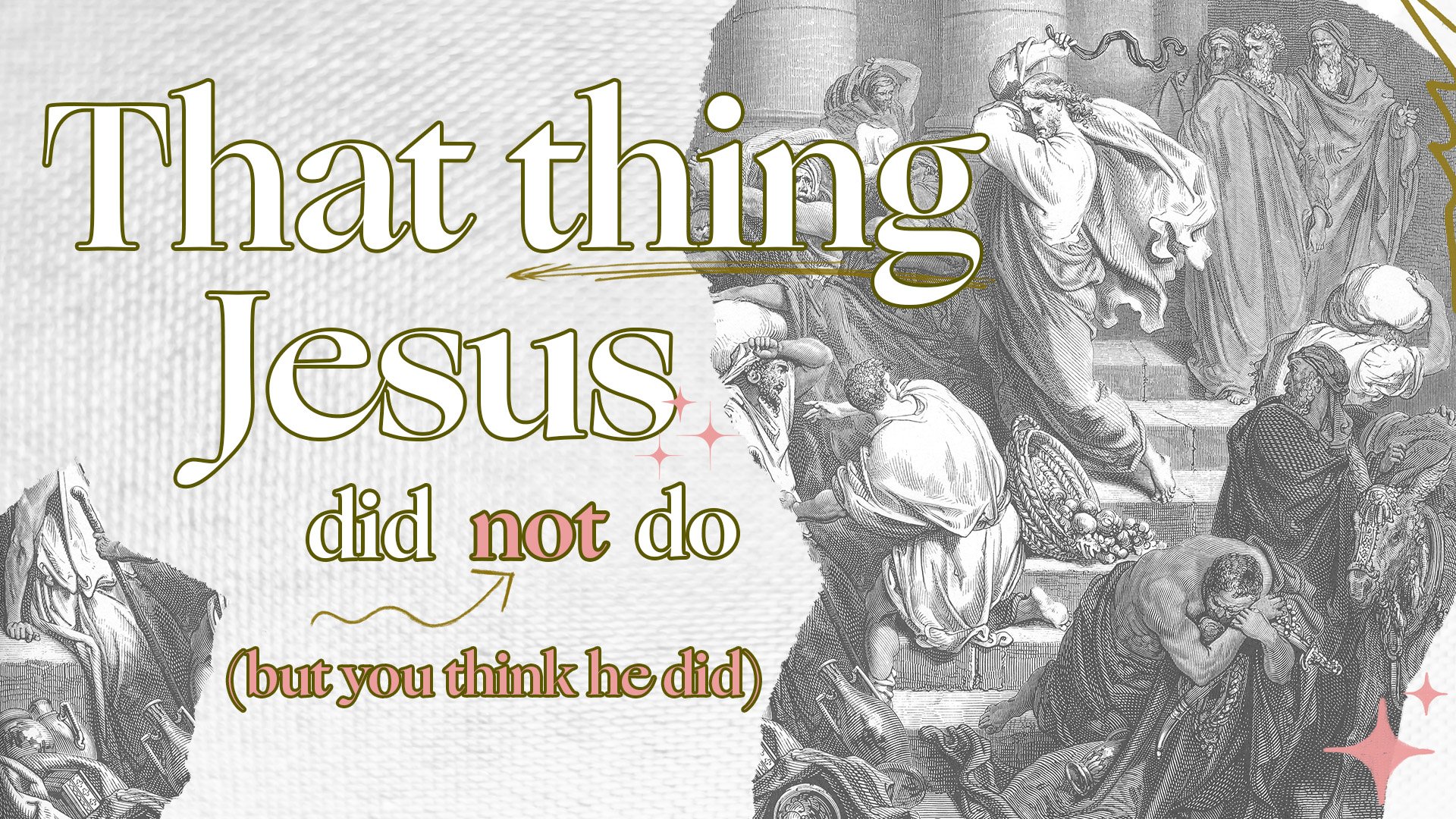
That Thing Jesus Did Not Do (But You Think He Did)
he common reaction to this scene in John is that Jesus walked up to the temple, saw the money changers and merchants handling their business, and in a moment of pure, holy rage twisted together a whip and created an Indiana Jones salvation moment, flipping tables and screaming at the Nazis. Quite the opposite of a berserked warrior hero, Jesus is about to lay down his life and take upon himself the shame of this crooked marketplace.
For years, memes have gone around that have some iteration of this language: “When someone says, ‘what would Jesus do,’ remember that flipping tables and chasing people with a whip is within the realm of possibilities.”
It’s funny, right?
Sure.
I understand that I am one of the most boring people on the planet. I need a better sense of humor. I’m not fun. I’ll admit that up front.
I still think this meme reveals a fatal flaw in how we see Jesus in this story. Because if we’re not careful, we’ll think that even on some funny level, this story shows Jesus being angry, forceful, and donning a sort of mid-century John Wayne grit amidst a bunch of crooked religious higher-ups and politicians.
And maybe there’s a slight twinge of truth in that last idea, but I wouldn’t even go that far.
The common reaction to this scene in John is that Jesus walked up to the temple, saw the money changers and merchants handling their business, and in a moment of pure, holy rage twisted together a whip and created an Indiana Jones salvation moment, flipping tables and screaming at the Nazis.
Let’s read it (This excerpt is from John chapter 2, though the story shows up in each gospel):
The Jewish Passover was near, and so Jesus went up to Jerusalem. In the temple he found people selling oxen, sheep, and doves, and he also found the money changers sitting there. After making a whip out of cords, he drove everyone out of the temple with their sheep and oxen. He also poured out the money changers’ coins and overturned the tables. He told those who were selling doves, “Get these things out of here! Stop turning my Father’s house into a marketplace!
There you have it. Jesus shows us righteous anger and wipes the floor of all evil; so let’s not throw out the possibility that Christians might need to brandish their whips and flip tables when something is corrupt.
With love in my heart, I would like to wholeheartedly reject that idea.
Jesus grew up within the second-temple Jewish tradition (Lk. 2:21-24; 41-47; 4:16), and visited the temple numerous times throughout his life. Flavius Josephus describes the bustling marketplace of the temple that existed in Jesus’ day, so this was not a new development that popped up during his visit in John’s gospel. Jesus saw this corruption every time he went to Jerusalem and visited the temple. The audacity of the marketplace corrupting the temple was no surprise to Jesus.
So why did he choose this visit to drive every merchant out of the temple?
If you look at this story in all four gospels, you’ll find that they all share a couple of elements of the narrative. (Only in John does he “make” a whip and pour out coins. In Luke, he doesn’t overturn any tables. In Mark, he stops people from carrying their goods into the temple. In Matthew and Mark, he overturns the seats of the dove sellers.)
But one event takes place in all four gospels: He drives out the merchants.
And he says these powerful words, “Stop turning my Father’s house into a marketplace!”
The Greek plays on the word “house.” The Greek phrase (οἶκον ἐμπορίου) often translates as “marketplace." But in English, this misses the clever wordplay. John is highlighting not the offensive activity itself, but its location. The “house” of God, the temple where His presence dwells, is meant to bring love and justice to those graced by it. The holy presence of God should fill the “house,” and Jesus (who is God himself, the true light, life, temple, bread, water, vine, land, and source) alone has all authority to correct this injustice.
The issue at play is that a place meant to act as the divine dwelling between heaven and earth, the safe and sacred living room between the God of the cosmos and his beloved creation, has become a place where those unfit to offer what God truly desires (the religious elite) have turned it into a system that elevates themselves at the expense of others. But Jesus chooses this moment to initiate his “cleansing” of God’s house because this story sets in motion a series of events that lead to his ultimate sacrifice. In the other three gospels, this narrative occurs during Jesus’ final week of ministry, before he is arrested and sentenced to death. In John, the story happens much earlier, but that’s because John is making a bigger theological claim.
Watch this.
Go back to the beginning of John chapter 2. You’ll notice that Jesus attends a wedding, where he performs a rather simple miracle, turning water into wine. This story is teeming with beautiful imagery: Jesus takes ceremonial washing jars used for ritual purification and produces the most satisfying wine the master of the banquet has ever tasted.
Imagine God the Father is the master of the banquet, and all the wine that came before this moment was not satisfying. It wasn’t perfect; it wasn’t truly what the Master considered “the best” (John 2:10). Now, imagine the wine is the blood of every sacrifice in the Old Testament system. It was never enough. It never satisfied. It always needed something more. Then Jesus shows up, and he (only he) produces the wine that finally satisfies, and the Father says, “This outtastes every offering that ever came before.”
Jesus, who was initially the guest at the wedding, became the host and satisfied perfectly every need among the people and the master of the banquet. Jesus has come to once and for all offer the greatest offering that could be offered, and he himself will become that offering, displacing all other offerings.
Now look again at Jesus as he drives the merchants from the market who dare attempt to make sacrifices available for the people, and at a profit no less. Jesus removes them, but ultimately sets in motion a series of events that will lead him to take the place of every sacrificial offering sold in that market. He doesn’t just displace them, he becomes them. John needs this narrative to take place earlier in the story to show how this action ties to Jesus’ role as both God and sacrifice, displacing and fulfilling the entire sacrificial system. Because after this moment in John’s gospel, people start to believe in Jesus, and whenever people believe in John’s gospel, Jewish elites start hunting him.
Not only is Jesus self-controlled and non-violent in this story, but he is also preparing everyone for his self-sacrificing act.
As Edward Klink puts it, “God in the person of Jesus has just entered his temple, declared it unclean, and has prepared to receive its shame himself.”
Quite the opposite of a berserked warrior hero, Jesus is about to lay down his life and take upon himself the shame of this crooked marketplace. That's why John, the author, cites Psalm 69:9: “zeal for your house will consume me.” Because the people revile God with their twisted worship, and they are about to revile Jesus as well. But Jesus willingly takes on their disdain so he can give God what everyone needs and what God truly wants: The perfect offering that will end all offerings. Jesus is intentional and calculated. Now is the time to repurpose practices in the temple courts, which Jesus says will be destroyed and rebuilt in three days.
He’s talking about himself, not the physical temple (2:19-21).
Jesus will perform the most powerful act in all of history: He will stand up to the epitome of brutal, grotesque violence in the known world, the Roman Empire, and willingly lay down his life for their sake, undoing their power and restoring the presence of God to the “house” of God.
The same God who once established these sacrificial rites is now walking among you, fulfilling this system with a more perfect one and driving out the corrupt corporate seats of power, just as He drives out the corrupt seats of power in the whole cosmos and tramples over them in victory (Col 2:15).
The same God who commanded offerings and sacrifices to facilitate his presence will become the one, perfect sacrifice, sufficient once for all, more satisfying than all sacrifices that came before.
Every animal offering is now useless; every currency and cost now worthless, and every market intermediary jobless. The “house” of God needs no such things anymore, and no one will be given the chance to exploit the system ever again, for Christ has come to fulfill it all, and in Him the presence of God will dwell fully.
That's the beauty of the temple cleansing narrative, and it’s the beauty of the dynamic, sacred actions of Jesus, who himself has the authority to drive everyone out and restore the house of God to what it was always meant to be.
The death and resurrection of Jesus will be the ultimate temple cleansing.
Peace, gentleness, and self-control will always be considered fruits of the spirit (Gal. 5:22-23), and no story of Jesus should be twisted to undermine them. We don’t have to mistake passion for emotional intensity. Jesus was passionate, but he was not out of control.
I wonder sometimes if we in the West have an obsession with emotional intensity. We like big revivals and spitting preachers. We like busyness and frenetic paces. We like loudness and forcefulness and wild abandon, and there is nothing inherently wrong with all of those things. But maybe we paint Jesus in a light that matches that intensity because we want Jesus to conform to our image rather than be conformed to his. Do we really need a loud, angsty, short-tempered, aggressive Jesus to defeat evil? Does Jesus need to be a cowboy of the wild west to be victorious? We all want to see the humanity of Jesus so we can resonate with him who understands our pain and suffering (Heb. 4:15), but how far do we take that?
These are not rhetorical questions. Can we at least stop and ponder them for a bit?
Did Jesus crash out?
I don’t think he did.